







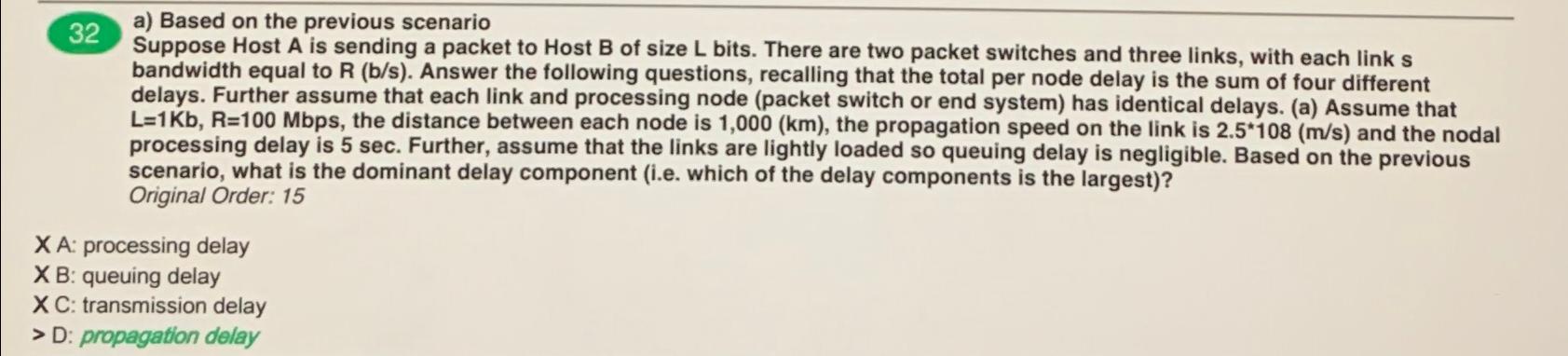
Question: 3 2 a ) Based on the previous scenario Suppose Host A is sending a packet to Host B of size L bits. There are
a Based on the previous scenario
Suppose Host A is sending a packet to Host B of size L bits. There are two packet switches and three links, with each link s bandwidth equal to Answer the following questions, recalling that the total per node delay is the sum of four different delays. Further assume that each link and processing node packet switch or end system has identical delays. a Assume that the distance between each node is the propagation speed on the link is and the nodal processing delay is Further, assume that the links are lightly loaded so queuing delay is negligible. Based on the previous scenario, what is the dominant delay component ie which of the delay components is the largest
Original Order:
X A: processing delay
: queuing delay
: transmission delay
Step by Step Solution
There are 3 Steps involved in it
1 Expert Approved Answer
Step: 1 Unlock

Question Has Been Solved by an Expert!
Get step-by-step solutions from verified subject matter experts
Step: 2 Unlock
Step: 3 Unlock
 Study Help