







Question: 3. (20 points) A representative household solves the following problem:. maxE0t=0tu(Ct,mt,1Nt)s.t.Ct+Kt+mt+bt=Yt+(1)Kt1+1+t1mt1+1+t1+it1bt1+t All of the variables and notations are the same as those defined in class.
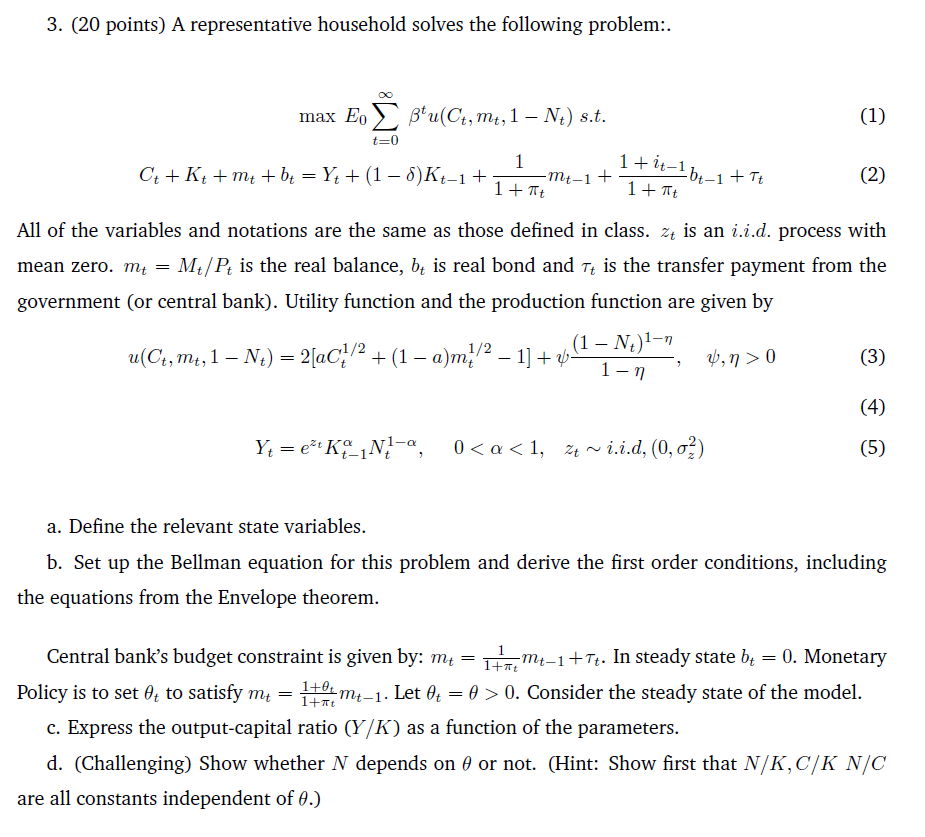
3. (20 points) A representative household solves the following problem:. maxE0t=0tu(Ct,mt,1Nt)s.t.Ct+Kt+mt+bt=Yt+(1)Kt1+1+t1mt1+1+t1+it1bt1+t All of the variables and notations are the same as those defined in class. zt is an i.i.d. process with mean zero. mt=Mt/Pt is the real balance, bt is real bond and t is the transfer payment from the government (or central bank). Utility function and the production function are given by u(Ct,mt,1Nt)=2[aCt1/2+(1a)mt1/21]+1(1Nt)1,,>0 Yt=eztKt1Nt1,00. Consider the steady state of the model. c. Express the output-capital ratio (Y/K) as a function of the parameters. d. (Challenging) Show whether N depends on or not. (Hint: Show first that N/K,C/KN/C are all constants independent of .) 3. (20 points) A representative household solves the following problem:. maxE0t=0tu(Ct,mt,1Nt)s.t.Ct+Kt+mt+bt=Yt+(1)Kt1+1+t1mt1+1+t1+it1bt1+t All of the variables and notations are the same as those defined in class. zt is an i.i.d. process with mean zero. mt=Mt/Pt is the real balance, bt is real bond and t is the transfer payment from the government (or central bank). Utility function and the production function are given by u(Ct,mt,1Nt)=2[aCt1/2+(1a)mt1/21]+1(1Nt)1,,>0 Yt=eztKt1Nt1,00. Consider the steady state of the model. c. Express the output-capital ratio (Y/K) as a function of the parameters. d. (Challenging) Show whether N depends on or not. (Hint: Show first that N/K,C/KN/C are all constants independent of .)
Step by Step Solution
There are 3 Steps involved in it

Get step-by-step solutions from verified subject matter experts
 Study Help