







Question: 3. (20 points) Modify the two-bidder example above and allow only three possible bids, 0, 1/2, or 1. (a) In a first-price auction, what are
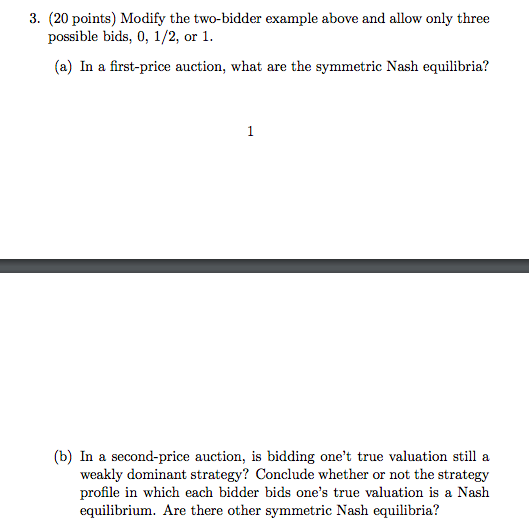
3. (20 points) Modify the two-bidder example above and allow only three possible bids, 0, 1/2, or 1. (a) In a first-price auction, what are the symmetric Nash equilibria? 1 (b) In a second-price auction, is bidding one't true valuation still a weakly dominant strategy? Conclude whether or not the strategy profile in which each bidder bids one's true valuation is a Nash equilibrium. Are there other symmetric Nash equilibria? 3. (20 points) Modify the two-bidder example above and allow only three possible bids, 0, 1/2, or 1. (a) In a first-price auction, what are the symmetric Nash equilibria? 1 (b) In a second-price auction, is bidding one't true valuation still a weakly dominant strategy? Conclude whether or not the strategy profile in which each bidder bids one's true valuation is a Nash equilibrium. Are there other symmetric Nash equilibria
Step by Step Solution
There are 3 Steps involved in it

Get step-by-step solutions from verified subject matter experts
 Study Help