







Question: 3. (20 Total Points) Suppose a consumer's utility function is given by U(X, Y) = MIN (4X, Y). Also, the consumer has $42 to spend,
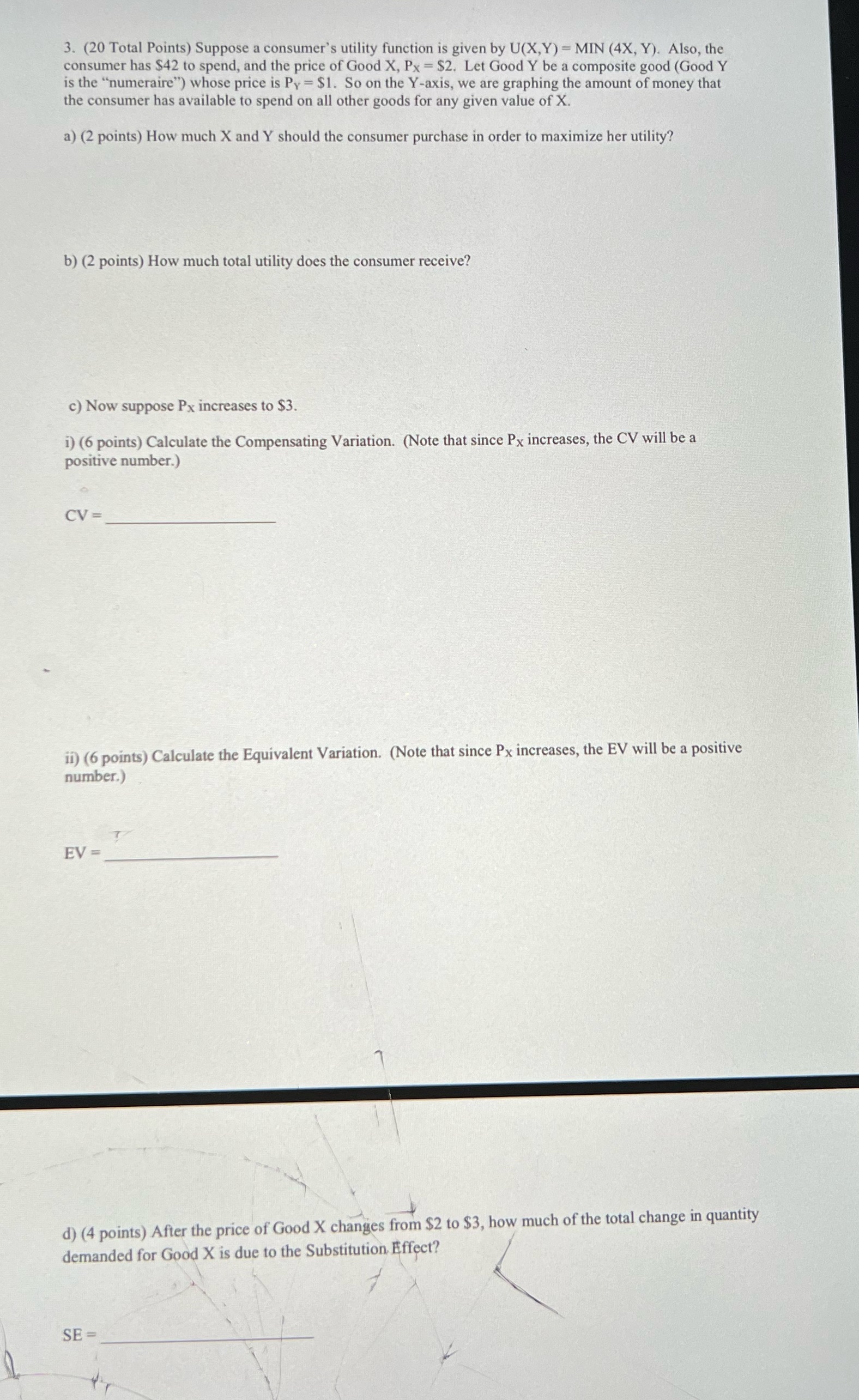
3. (20 Total Points) Suppose a consumer's utility function is given by U(X, Y) = MIN (4X, Y). Also, the consumer has $42 to spend, and the price of Good X, Px = $2. Let Good Y be a composite good (Good Y is the "numeraire") whose price is Py = $1. So on the Y-axis, we are graphing the amount of money that the consumer has available to spend on all other goods for any given value of X. a) (2 points) How much X and Y should the consumer purchase in order to maximize her utility? b) (2 points) How much total utility does the consumer receive? c) Now suppose Px increases to $3. i) (6 points) Calculate the Compensating Variation. (Note that since Px increases, the CV will be a positive number.) CV = ii) (6 points) Calculate the Equivalent Variation. (Note that since Px increases, the EV will be a positive number.) EV = d) (4 points) After the price of Good X changes from $2 to $3, how much of the total change in quantity demanded for Good X is due to the Substitution Effect? SE =
Step by Step Solution
There are 3 Steps involved in it
Lets solve the problem step by step a Maximizing Utility The utility function is given by UX Y textM... View full answer

Get step-by-step solutions from verified subject matter experts
 Study Help