







Question: 3 2.5 / 20 points Given a surface z = f(x, y) := ye *y. (the notation :=' means 'define as) 1. Find partial derivatives:
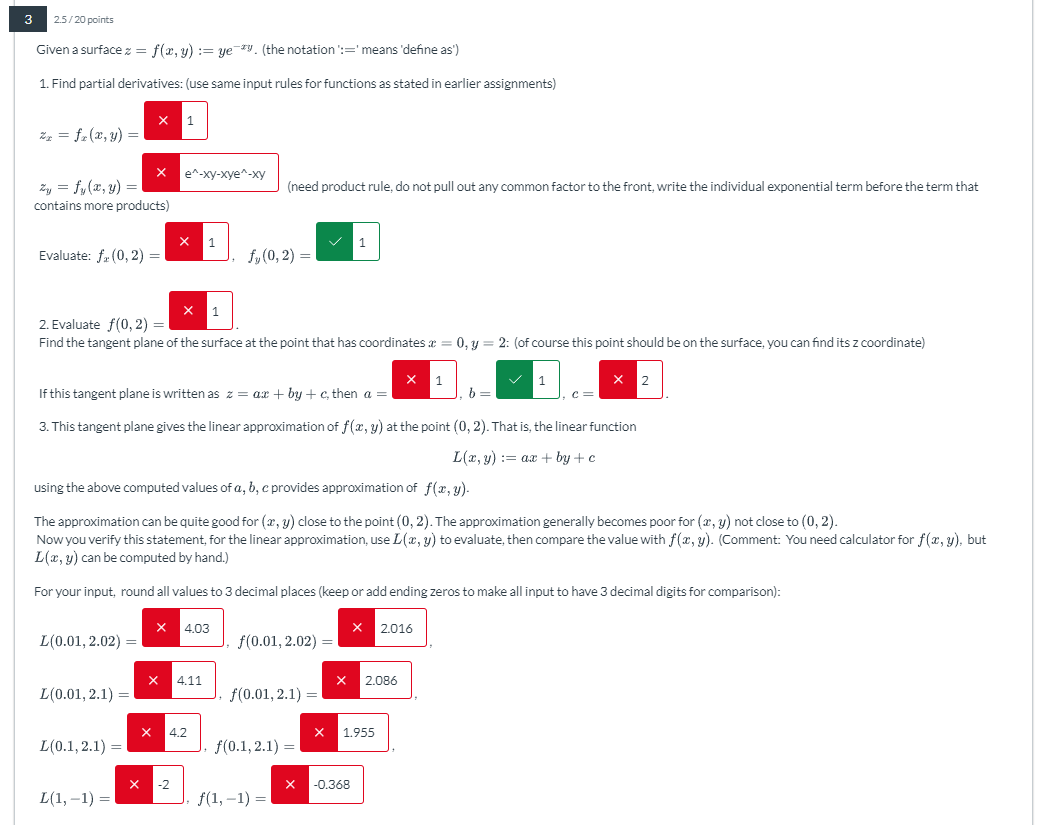
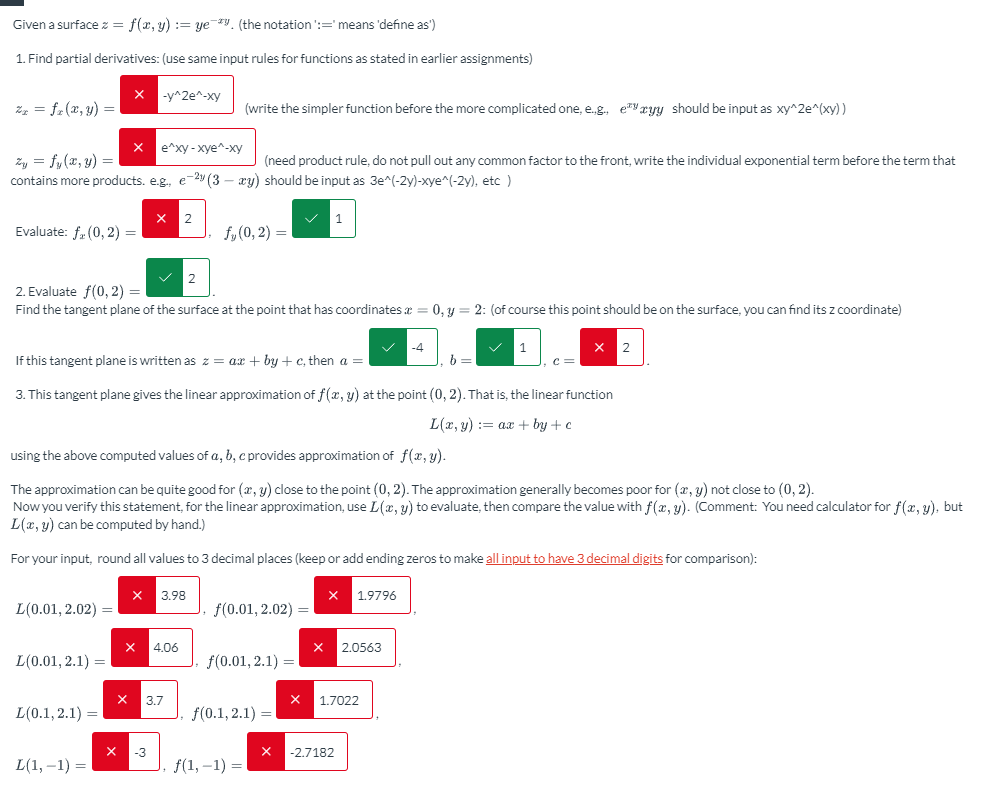
3 2.5 / 20 points Given a surface z = f(x, y) := ye *y. (the notation :=' means 'define as") 1. Find partial derivatives: (use same input rules for functions as stated in earlier assignments) X 1 Ex = fx(x, y) = X e*-xy-xye*-xy Zy = fy(x, y) = (need product rule, do not pull out any common factor to the front, write the individual exponential term before the term that contains more products) X 1 1 Evaluate: fx (0, 2) = fy (0, 2) = X 1 2. Evaluate f(0, 2) = Find the tangent plane of the surface at the point that has coordinates a = 0, y = 2: (of course this point should be on the surface, you can find its z coordinate) X 1 1 If this tangent plane is written as z = ax + by + c, then a = X 2 3. This tangent plane gives the linear approximation of f(a, y) at the point (0, 2). That is, the linear function L(x, y) := ax + by + c using the above computed values of a, b, c provides approximation of f(x, y)- The approximation can be quite good for (2, y) close to the point (0, 2). The approximation generally becomes poor for (a, y) not close to (0, 2). Now you verify this statement, for the linear approximation, use L(x, y) to evaluate, then compare the value with f(x, y). (Comment: You need calculator for f (x, y), but L(a, y) can be computed by hand.) For your input, round all values to 3 decimal places (keep or add ending zeros to make all input to have 3 decimal digits for comparison): X 4.03 X 2.016 L(0.01, 2.02) = f(0.01, 2.02) = X 4.11 X 2.086 L(0.01, 2.1) = f (0.01, 2.1) = X 4.2 X 1.955 L(0.1, 2.1) f(0.1, 2.1) X -2 X -0.368 L(1, -1) f(1, -1)Givenasurface z = flx,y) := ye *. (the notation 1= means 'define as') 1. Find partial derivatives: (use same input rules for functions as stated in earlier assignments) X ety = folz,y) = (write the simpler function before the more complicated one, ez, exyy should be input as xy~2exy)) = f{, (z,y) (need product rule, do not pull out any commaon factor to the front, write the individual exponential term before the term that contalns more products eg, P'E'f 3 xy) should beinput as 3e-2y}-xye(-2y), etc ) ! Evaluate: ,.{0,2) = - f(0,2) = 2 Evaluate f{0,2) Find the tangent plane of the surface at the point that has coordinates & = 0, = 2: (of course this point should be on the surface, you can find its z coordinate) R If this tangent plane is written as z = ax + by + e, then a = - b 3. This tangent plane gives the linear approximation of f(z, y) at the point {0, 2). That is, the linear function Liz,y):==ax+ by +c using the abowve computed values of a, b, e provides approximation of f(z, y). The approximation can be guite good for (z, ) close to the point {0, 2). The approximation generally becomes poor for {2, ) not close to (0, 2). Mow you verify this statement, for the linear approximation, use L( z, i) to evaluate, then compare the value with f{z, a,r] {Comment: You need calculator for f{z, y), but L(x, y) can be computed by hand.) For your input, round all values to 3 decimal places (keep or add ending zeros to make all input to have 3 decimal digits for comparison): L(0.01,2.02) . fl0.01,2.02) L{0.01,2.1) . fl0.01,2.1) = L{0.1,2.1) = . fl0.1,2.1) = -f\
Step by Step Solution
There are 3 Steps involved in it

Get step-by-step solutions from verified subject matter experts
 Study Help