







Question: 3. (25 points} Two different analytical tests can be used to determine the impurity level in steel alloys. Eight specimens are tested using both procedures,
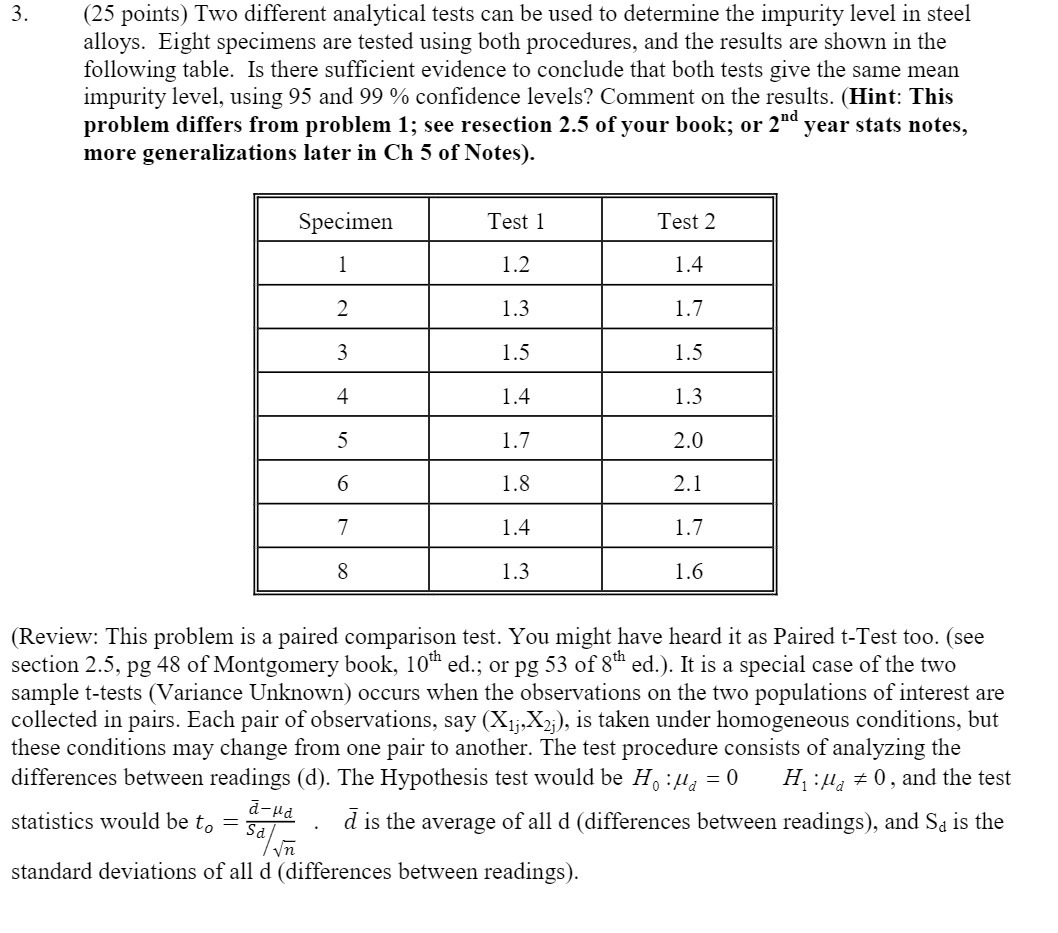
3. (25 points} Two different analytical tests can be used to determine the impurity level in steel alloys. Eight specimens are tested using both procedures, and the results are shown in the following table. Is there sufcient evidence to conclude that both tests give the same mean impurity level, using 95 and 99 % condence levels? Comment on the results. (Hint: This problem differs from problem 1; see resection 2.5 of your book; or 2Illi year stats notes, more generalizations later in Ch 5 of Notes). |___ |___ I I |___ I |__ I l__ (Review: This problem is a paired comparison test. You might have heard it as Paired t-Test too. (see section 2.5, pg 48 ofMontgornery book, 10tll ed.; or pg 53 of 8th ed). It is a special case of the two sample t-tests (Variance Unknown) occurs when the observations on the two populations of interest are collected in pairs. Each pair of observations, say (Kb-9(2)), is taken under homogeneous conditions, but these conditions may change from one pair to another. The test procedure consists of analyzing the differences between readings (d). The Hypothesis test would be H0 :yd : 0 H1 34\".: 7: 0 , and the test Ed}: . d is the average of all (:1 (differences between readings), and $6 is the standard deviations of all d (differences between readings). statistics would be to
Step by Step Solution
There are 3 Steps involved in it

Get step-by-step solutions from verified subject matter experts
 Study Help