







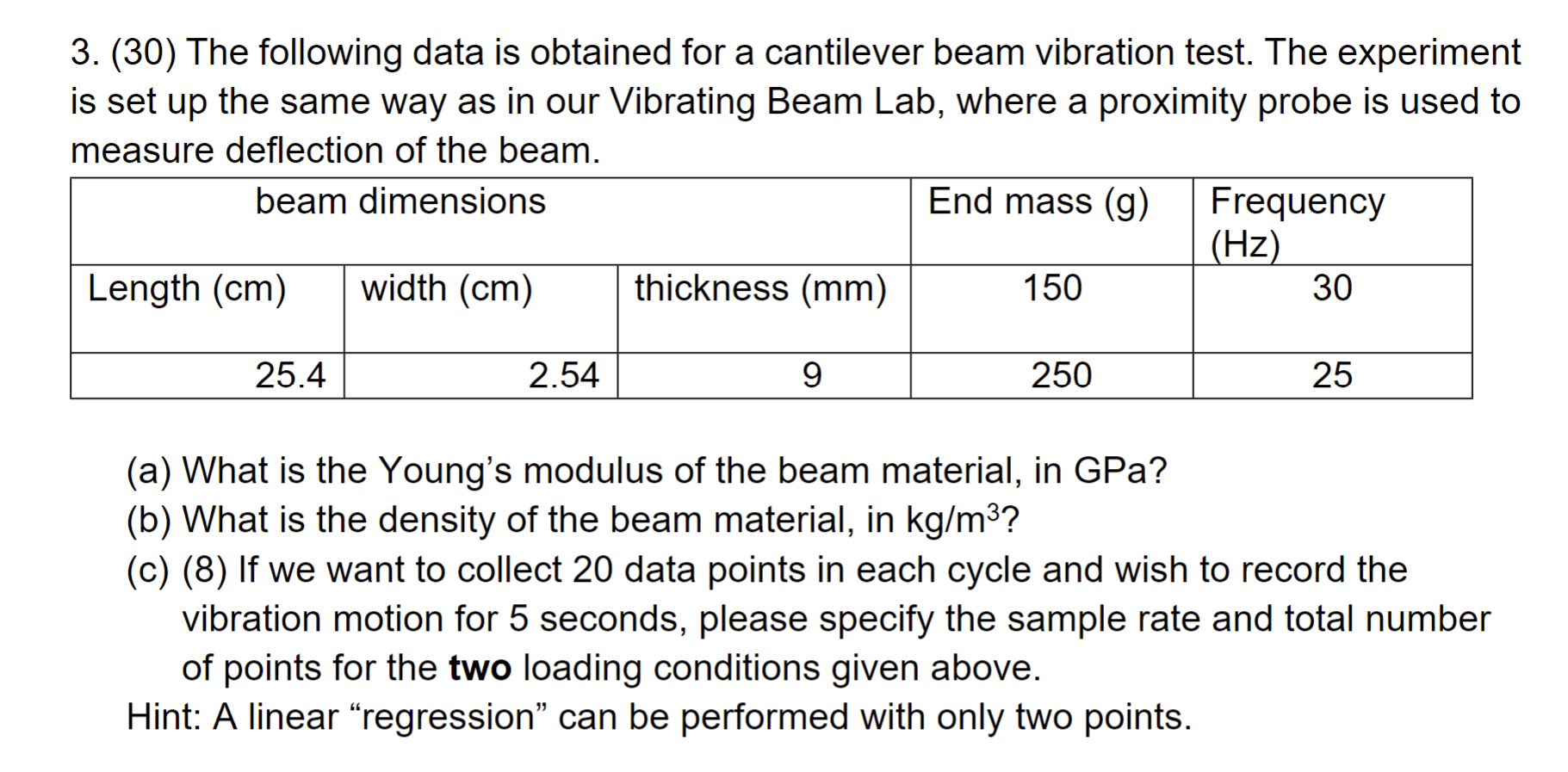
Question: 3 . ( 3 0 ) The following data is obtained for a cantilever beam vibration test. The experiment is set up the same way
The following data is obtained for a cantilever beam vibration test. The experiment is set up the same way as in our Vibrating Beam Lab, where a proximity probe is used to measure deflection of the beam.
begintabularrllcc
hline multicolumnc beam dimensions & End mass g & begintabularl
Frequency
mathrmHz
endtabular
hline Length mathrmcm & width mathrmcm & thickness mathrmmm & &
hline & & & &
hline
endtabular
a What is the Young's modulus of the beam material, in GPa?
b What is the density of the beam material, in mathrmkgmathrmm
c If we want to collect data points in each cycle and wish to record the vibration motion for seconds, please specify the sample rate and total number of points for the two loading conditions given above.
Hint: A linear "regression" can be performed with only two points.
Step by Step Solution
There are 3 Steps involved in it
1 Expert Approved Answer
Step: 1 Unlock

Question Has Been Solved by an Expert!
Get step-by-step solutions from verified subject matter experts
Step: 2 Unlock
Step: 3 Unlock
 Study Help