



Question: 3. (30 pts) In a small LTE network we intend to calculate the carrier to interference ratio (C/1) that a mobile subscriber is experiencing when
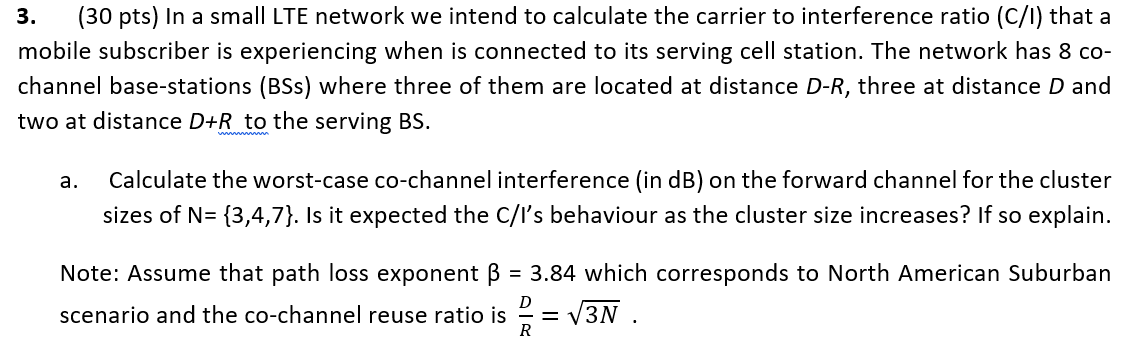
3. (30 pts) In a small LTE network we intend to calculate the carrier to interference ratio (C/1) that a mobile subscriber is experiencing when is connected to its serving cell station. The network has 8 co- channel base-stations (BSs) where three of them are located at distance D-R, three at distance D and two at distance D+R to the serving BS. a. Calculate the worst-case co-channel interference (in dB) on the forward channel for the cluster sizes of N= {3,4,7}. Is it expected the C/l's behaviour as the cluster size increases? If so explain. Note: Assume that path loss exponent = 3.84 which corresponds to North American Suburban scenario and the co-channel reuse ratio is B = V3N 3. (30 pts) In a small LTE network we intend to calculate the carrier to interference ratio (C/1) that a mobile subscriber is experiencing when is connected to its serving cell station. The network has 8 co- channel base-stations (BSs) where three of them are located at distance D-R, three at distance D and two at distance D+R to the serving BS. a. Calculate the worst-case co-channel interference (in dB) on the forward channel for the cluster sizes of N= {3,4,7}. Is it expected the C/l's behaviour as the cluster size increases? If so explain. Note: Assume that path loss exponent = 3.84 which corresponds to North American Suburban scenario and the co-channel reuse ratio is B = V3N
Step by Step Solution
There are 3 Steps involved in it

Get step-by-step solutions from verified subject matter experts