







Question: 3. (35pts) In this question, we explain why quick sort is faster than merge sort in usual cases. We saw that the running time recurrence
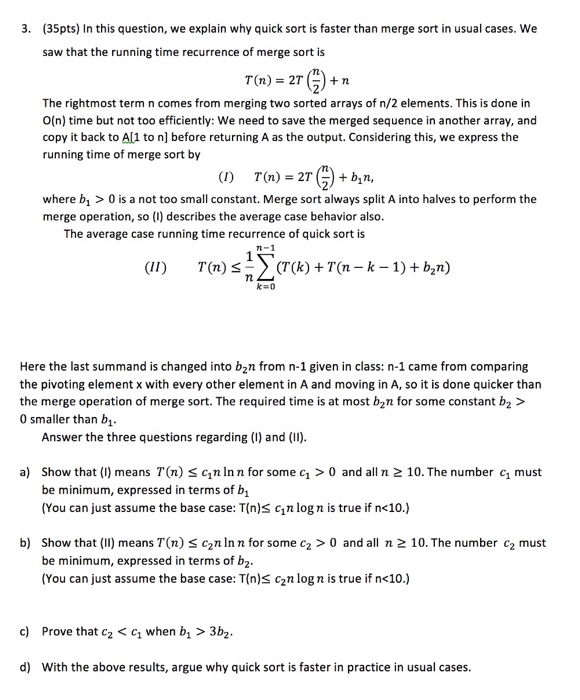
3. (35pts) In this question, we explain why quick sort is faster than merge sort in usual cases. We saw that the running time recurrence of merge sort is T(n)-2T + n The rightmost term n comes from merging two sorted arrays of n/2 elements. This is done in O(n) time but not too efficiently: We need to save the merged sequence in another array, and copy it back to Al1 to n] before returning A as the output. Considering this, we express the running time of merge sort by (C) T(n) -n, where b1>0 is a not too small constant. Merge sort always split A into halves to perform the merge operation, so (I) describes the average case behavior also. The average case running time recurrence of quick sort is (II) T(n) s- (T(k) +T(n - k -1) + bzn) k-0 Here the last summand is changed into b2n from n-1 given in class: n-1 came from comparing the pivoting element x with every other element in A and moving in A, so it is done quicker than the merge operation of merge sort. The required time is at most b2n for some constant b2 > 0 smaller than b Answer the three questions regarding (1) and (lI) a) Show that (I) means T(n) s c1n ln n for some c1 > 0 and all n 2 10. The number c1 must be minimum, expressed in terms of b (You can just assume the base case: T(n) cin logn is true if n0 and all n 2 10. The number c2 must be minimum, expressed in terms of b2. (You can just assume the base case: T(n)s c2n logn is true if n 3b2 d) With the above results, argue why quick sort is faster in practice in usual cases
Step by Step Solution
There are 3 Steps involved in it

Get step-by-step solutions from verified subject matter experts
 Study Help