







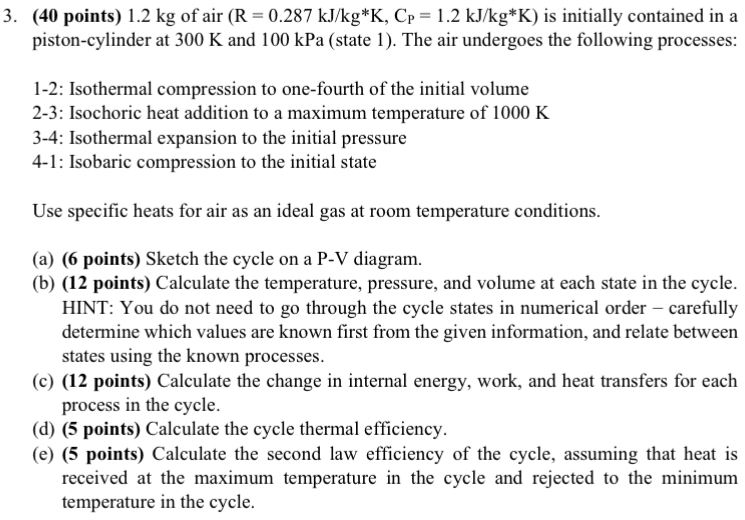
Question: 3 . ( 4 0 points ) 1 . 2 kg of air ( left ( mathrm { R } = 0
points kg of air leftmathrmRmathrm~kJmathrmkgmathrm~KmathrmCmathrmPmathrm~kJmathrmkgmathrm~Kright is initially contained in a pistoncylinder at K and kPa state The air undergoes the following processes:
: Isothermal compression to onefourth of the initial volume
: Isochoric heat addition to a maximum temperature of K
: Isothermal expansion to the initial pressure
: Isobaric compression to the initial state
Use specific heats for air as an ideal gas at room temperature conditions.
a points Sketch the cycle on a PV diagram.
b points Calculate the temperature, pressure, and volume at each state in the cycle. HINT: You do not need to go through the cycle states in numerical order carefully determine which values are known first from the given information, and relate between states using the known processes.
c points Calculate the change in internal energy, work, and heat transfers for each process in the cycle.
d points Calculate the cycle thermal efficiency.
e points Calculate the second law efficiency of the cycle, assuming that heat is received at the maximum temperature in the cycle and rejected to the minimum temperature in the cycle.
Step by Step Solution
There are 3 Steps involved in it
1 Expert Approved Answer
Step: 1 Unlock

Question Has Been Solved by an Expert!
Get step-by-step solutions from verified subject matter experts
Step: 2 Unlock
Step: 3 Unlock
 Study Help