







Question: 3. [-/4 Points] DETAILS MY NOTES ASK YOUR TEACHER PRACTICE ANOTHER A projectile of mass 2.0 kg is fired in the air at an angle
![3. [-/4 Points] DETAILS MY NOTES ASK YOUR TEACHER PRACTICE ANOTHER](https://s3.amazonaws.com/si.experts.images/answers/2024/06/6676e8a52e133_8376676e8a510353.jpg)

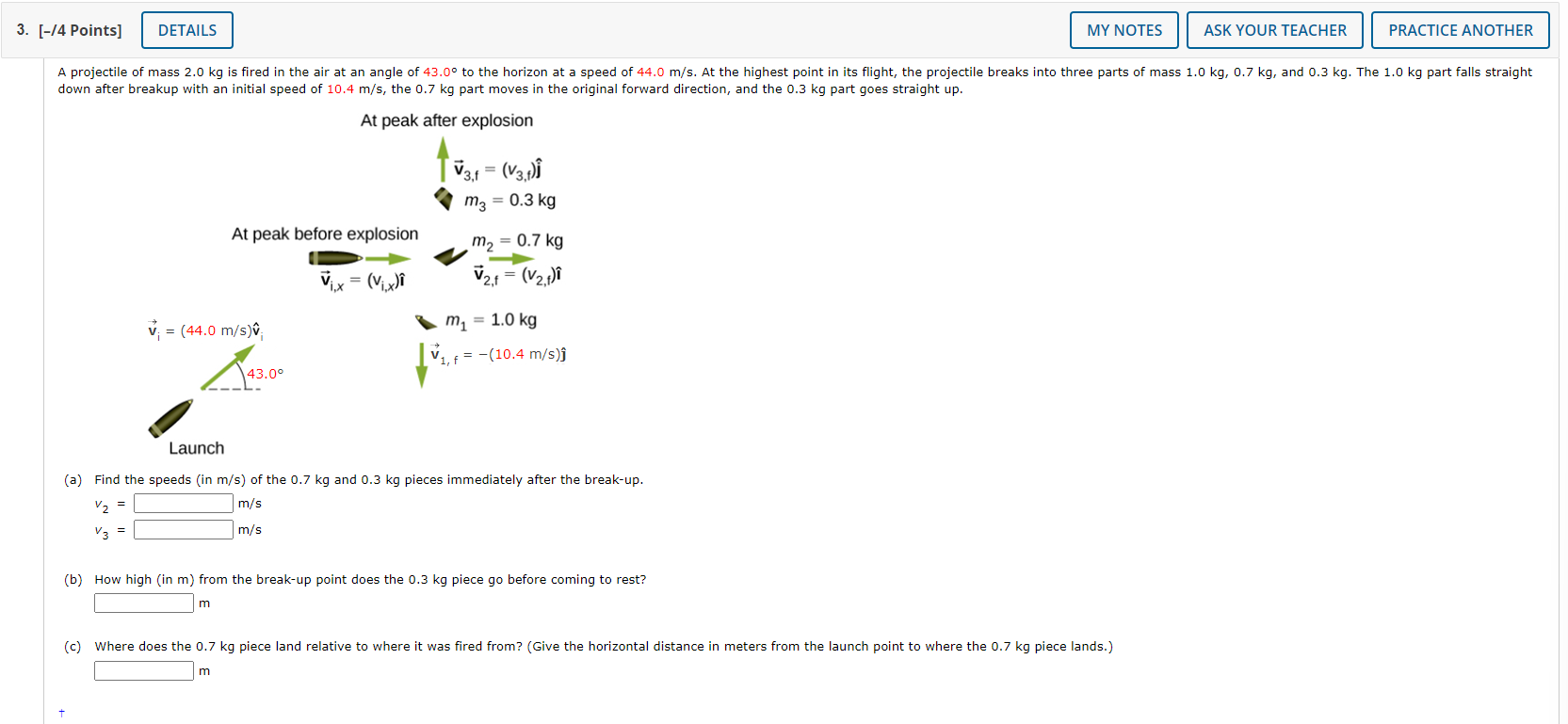

3. [-/4 Points] DETAILS MY NOTES ASK YOUR TEACHER PRACTICE ANOTHER A projectile of mass 2.0 kg is fired in the air at an angle of 43.0 to the horizon at a speed of 44.0 m/s. At the highest point in its flight, the projectile breaks into three parts of mass 1.0 kg, 0.7 kg, and 0.3 kg. The 1.0 kg part falls straight down after breakup with an initial speed of 10.4 m/s, the 0.7 kg part moves in the original forward direction, and the 0.3 kg part goes straight up. At peak after explosion V3.1 = (V3.1)j m3 = 0.3 kg At peak before explosion m2 = 0.7 kg Vix = (Vix)i V 2.t = ( V 2,1)1 V . = ( 44.0 m /s) v m1 = 1.0 kg 43.00 | V1, f = -(10.4 m/s)j Launch (a) Find the speeds (in m/s) of the 0.7 kg and 0.3 kg pieces immediately after the break-up. V2 m/s V 3 m/s (b) How high (in m) from the break-up point does the 0.3 kg piece go before coming to rest? m (c) Where does the 0.7 kg piece land relative to where it was fired from? (Give the horizontal distance in meters from the launch point to where the 0.7 kg piece lands.) m4. [-/2 Points] DETAILS MY NOTES ASK YOUR TEACHER PRACTICE ANOTHER A 0.320 kg puck at rest on a horizontal frictionless surface is struck by a 0.220 kg puck moving in the positive x direction with a speed of 3.80 m/s. After the collision, the 0.220 kg puck has a speed of 1.30 m/s at an angle of 0 = 60.0 counterclockwise from the positive x axis. (a) Determine the velocity of the 0.320 kg puck after the collision. Express your answer in vector form. V 4 = n/s (b) Find the percent of kinetic energy lost in the collision. 100
Step by Step Solution
There are 3 Steps involved in it

Get step-by-step solutions from verified subject matter experts
 Study Help