







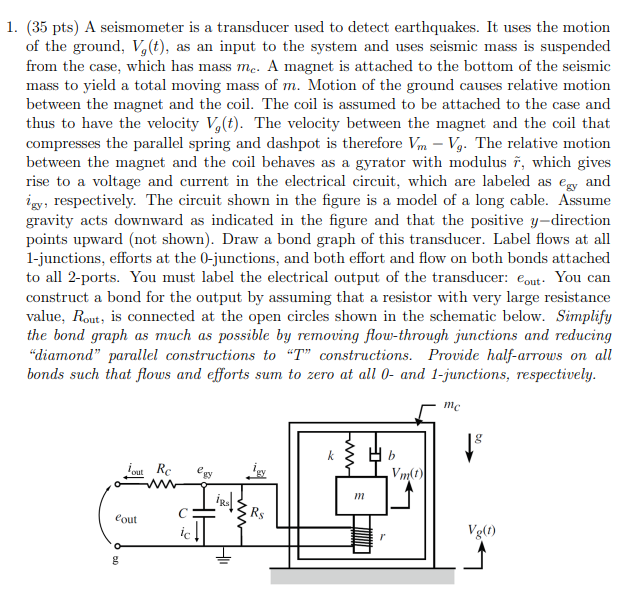
Question: ( 3 5 pts ) A seismometer is a transducer used to detect earthquakes. It uses the motion of the ground, V g ( t
pts A seismometer is a transducer used to detect earthquakes. It uses the motion
of the ground, as an input to the system and uses seismic mass is suspended
from the case, which has mass A magnet is attached to the bottom of the seismic
mass to yield a total moving mass of Motion of the ground causes relative motion
between the magnet and the coil. The coil is assumed to be attached to the case and
thus to have the velocity The velocity between the magnet and the coil that
compresses the parallel spring and dashpot is therefore The relative motion
between the magnet and the coil behaves as a gyrator with modulus tilde which gives
rise to a voltage and current in the electrical circuit, which are labeled as and
respectively. The circuit shown in the figure is a model of a long cable. Assume
gravity acts downward as indicated in the figure and that the positive direction
points upward not shown Draw a bond graph of this transducer. Label flows at all
junctions, efforts at the junctions, and both effort and flow on both bonds attached
to all ports. You must label the electrical output of the transducer: You can
construct a bond for the output by assuming that a resistor with very large resistance
value, is connected at the open circles shown in the schematic below. Simplify
the bond graph as much as possible by removing flowthrough junctions and reducing
"diamond" parallel constructions to T constructions. Provide halfarrows on all
bonds such that flows and efforts sum to zero at all and junctions, respectively.
Step by Step Solution
There are 3 Steps involved in it
1 Expert Approved Answer
Step: 1 Unlock

Question Has Been Solved by an Expert!
Get step-by-step solutions from verified subject matter experts
Step: 2 Unlock
Step: 3 Unlock
 Study Help