



Question: 3. [5] When you started reading Section 7.1, many of the equations should have been familiar from your last course in Classical Mechanics (e.g. PHY
![3. [5] When you started reading Section 7.1, many of the](https://dsd5zvtm8ll6.cloudfront.net/si.experts.images/questions/2024/09/66f6b43427679_01966f6b433ef98b.jpg)
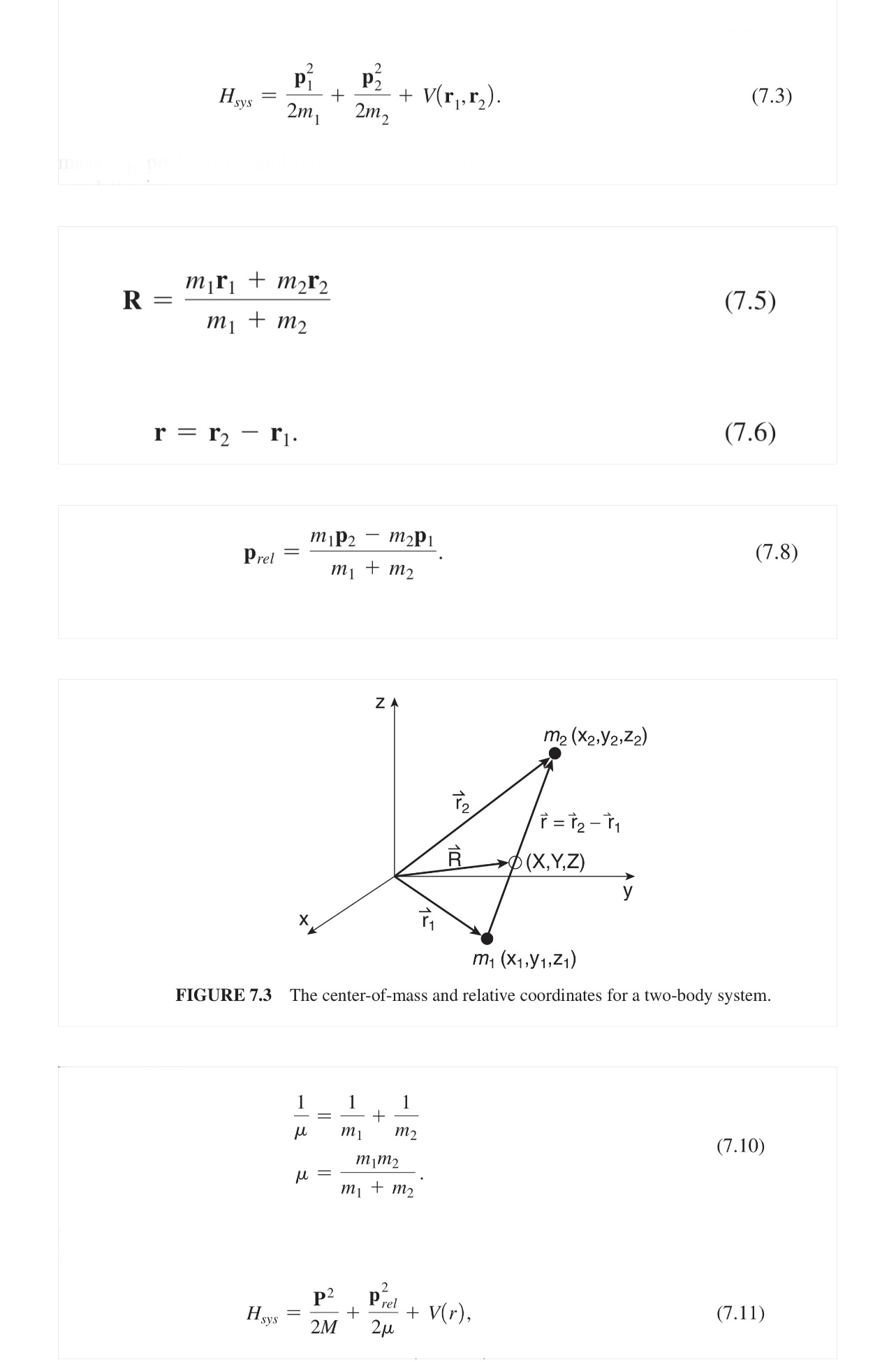
3. [5] When you started reading Section 7.1, many of the equations should have been familiar from your last course in Classical Mechanics (e.g. PHY 321 at MSU). But you may not innnediately recognize Eqn. (7.8). Let's reassure ourselves that it is correct. Note: I am using boldface font to represent vectors, consistent with McIntyre. a) [1] Let's forget about operators for the moment, and recall what we learned in Classical Mechanics. Invert Equations (7.5) and (7.6) to nd :7 and r: in terms of R and r. (You can get the answers by staring at Figure 7.3 without doing any algebra. But check your results.) b) [2] Take time derivatives of all position variables to get the individual partical velocities v: and v; in terms of the center-of-mass velocity and the relative velocity, V and 12m respectively. Plug those into the Classical form of the kinetic energy to show that 1 1 1 1 3m1v+ Emzvg = 3M1!2 + 5:11:39; where p is the reduced mass dened in Eqn. (7.10). If we dene P = IMF and pm = yum; then it's easy to see that Eqn. (7.11) follows from Eqn. (7.3). Show that Eqn. (7.8) follows from p\\f
Step by Step Solution
There are 3 Steps involved in it

Get step-by-step solutions from verified subject matter experts