







Question: 3) (50 points) FedEx Ground needs to build new package sorting facilities in order to meet U.S. demand for parcel shipping during the next 10
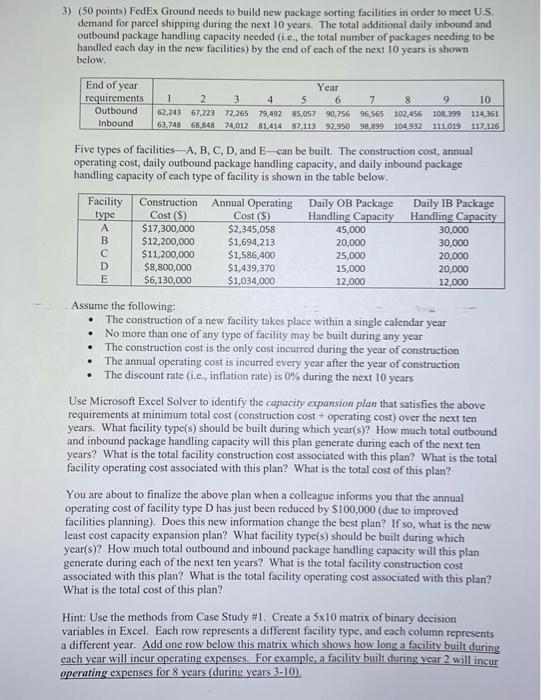
3) (50 points) FedEx Ground needs to build new package sorting facilities in order to meet U.S. demand for parcel shipping during the next 10 years. The total additional daily inbound and outbound package handling capacity needed (1.c., the total number of packages needing to be handled each day in the new facilities) by the end of each of the next 10 years is shown below. End of year requirements Outbound Inbound Year 1 2 3 4 5 6 7 8 9 10 62,243 67.223 72,26579,49285,057 90,756 96,565 102,456 108,399 114,361 63.748 68.848 74,012 81,414 87,113 92.950 98.899104932 111 019 117,126 . Five types of facilities A, B, C, D, and E-can be built. The construction cost, annual operating cost, daily outbound package handling capacity, and daily inbound package handling capacity of each type of facility is shown in the table below. Facility Construction Annual Operating Daily OB Package Daily IB Package type Cost (S) Cost (S) Handling CapacityHandling Capacity A $17,300,000 $2,345,058 45,000 30,000 B $12,200,000 $1,694,213 20,000 30,000 $11,200,000 $1,586,400 25,000 20,000 D $8,800,000 $1,439,370 15,000 20.000 E $6,130,000 $1,034,000 12,000 12,000 Assume the following: The construction of a new facility takes place within a single calendar year No more than one of any type of facility may be built during any year The construction cost is the only cost incurred during the year of construction The annual operating cost is incurred every year after the year of construction The discount rate (1.e., inflation rate) is 0% during the next 10 years Use Microsoft Excel Solver to identify the capacity expansion plan that satisfies the above requirements at minimum total cost (construction cost + operating cost) over the next ten years. What facility type() should be built during which year(s)? How much total outbound and inbound package handling capacity will this plan generate during each of the next ten years? What is the total facility construction cost associated with this plan? What is the total facility operating cost associated with this plan? What is the total cost of this plan? You are about to finalize the above plan when a colleague informs you that the annual operating cost of facility type D has just been reduced by $100,000 (due to improved facilities planning). Does this new information change the best plan? If so, what is the new least cost capacity expansion plan? What facility type(s) should be built during which year(s)? How much total outbound and inbound package handling capacity will this plan generate during each of the next ten years? What is the total facility construction cost associated with this plan? What is the total facility operating cost associated with this plan? What is the total cost of this plan? Hint: Use the methods from Case Study #1. Create a 3x10 matrix of binary decision variables in Excel. Each row represents a different facility type, and each column represents a different year. Add one row below this matrix which shows how long a facility built during each year will incur operating expenses. For example, a facility built during year 2 will incur operating expenses for 8 years (during years 3-10). 3) (50 points) FedEx Ground needs to build new package sorting facilities in order to meet U.S. demand for parcel shipping during the next 10 years. The total additional daily inbound and outbound package handling capacity needed (1.c., the total number of packages needing to be handled each day in the new facilities) by the end of each of the next 10 years is shown below. End of year requirements Outbound Inbound Year 1 2 3 4 5 6 7 8 9 10 62,243 67.223 72,26579,49285,057 90,756 96,565 102,456 108,399 114,361 63.748 68.848 74,012 81,414 87,113 92.950 98.899104932 111 019 117,126 . Five types of facilities A, B, C, D, and E-can be built. The construction cost, annual operating cost, daily outbound package handling capacity, and daily inbound package handling capacity of each type of facility is shown in the table below. Facility Construction Annual Operating Daily OB Package Daily IB Package type Cost (S) Cost (S) Handling CapacityHandling Capacity A $17,300,000 $2,345,058 45,000 30,000 B $12,200,000 $1,694,213 20,000 30,000 $11,200,000 $1,586,400 25,000 20,000 D $8,800,000 $1,439,370 15,000 20.000 E $6,130,000 $1,034,000 12,000 12,000 Assume the following: The construction of a new facility takes place within a single calendar year No more than one of any type of facility may be built during any year The construction cost is the only cost incurred during the year of construction The annual operating cost is incurred every year after the year of construction The discount rate (1.e., inflation rate) is 0% during the next 10 years Use Microsoft Excel Solver to identify the capacity expansion plan that satisfies the above requirements at minimum total cost (construction cost + operating cost) over the next ten years. What facility type() should be built during which year(s)? How much total outbound and inbound package handling capacity will this plan generate during each of the next ten years? What is the total facility construction cost associated with this plan? What is the total facility operating cost associated with this plan? What is the total cost of this plan? You are about to finalize the above plan when a colleague informs you that the annual operating cost of facility type D has just been reduced by $100,000 (due to improved facilities planning). Does this new information change the best plan? If so, what is the new least cost capacity expansion plan? What facility type(s) should be built during which year(s)? How much total outbound and inbound package handling capacity will this plan generate during each of the next ten years? What is the total facility construction cost associated with this plan? What is the total facility operating cost associated with this plan? What is the total cost of this plan? Hint: Use the methods from Case Study #1. Create a 3x10 matrix of binary decision variables in Excel. Each row represents a different facility type, and each column represents a different year. Add one row below this matrix which shows how long a facility built during each year will incur operating expenses. For example, a facility built during year 2 will incur operating expenses for 8 years (during years 3-10)
Step by Step Solution
There are 3 Steps involved in it

Get step-by-step solutions from verified subject matter experts
 Study Help