







Question: 3 . A 1 0 - inch ( times 1 0 ) - inch ( times 0 . 7 5
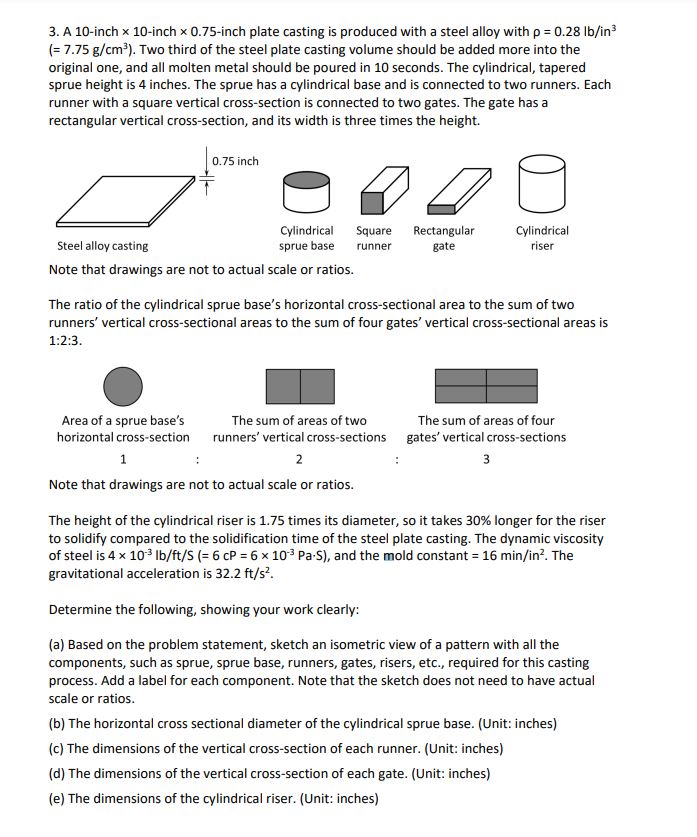
A inch times inch times inch plate casting is produced with a steel alloy with rhomathrmlbmathrminmathrm~gmathrmcm Two third of the steel plate casting volume should be added more into the original one, and all molten metal should be poured in seconds. The cylindrical, tapered sprue height is inches. The sprue has a cylindrical base and is connected to two runners. Each runner with a square vertical crosssection is connected to two gates. The gate has a rectangular vertical crosssection, and its width is three times the height.
The ratio of the cylindrical sprue base's horizontal crosssectional area to the sum of two runners' vertical crosssectional areas to the sum of four gates' vertical crosssectional areas is ::
Area of a sprue base's horizontal crosssection
The sum of areas of two runners' vertical crosssections
The sum of areas of four gates' vertical crosssections
Note that drawings are not to actual scale or ratios.
The height of the cylindrical riser is times its diameter, so it takes longer for the riser to solidify compared to the solidification time of the steel plate casting. The dynamic viscosity of steel is times mathrmlbmathrmftmathrmSleftmathrmcPtimes mathrm~Pacdot mathrm~Sright and the mold constant mathrm~minmathrmin The gravitational acceleration is mathrmftmathrms
Determine the following, showing your work clearly:
a Based on the problem statement, sketch an isometric view of a pattern with all the components, such as sprue, sprue base, runners, gates, risers, etc., required for this casting process. Add a label for each component. Note that the sketch does not need to have actual scale or ratios.
b The horizontal cross sectional diameter of the cylindrical sprue base. Unit: inches
c The dimensions of the vertical crosssection of each runner. Unit: inches
d The dimensions of the vertical crosssection of each gate. Unit: inches
e The dimensions of the cylindrical riser. Unit: inches
Step by Step Solution
There are 3 Steps involved in it
1 Expert Approved Answer
Step: 1 Unlock

Question Has Been Solved by an Expert!
Get step-by-step solutions from verified subject matter experts
Step: 2 Unlock
Step: 3 Unlock
 Study Help