







Question: 3. (a) (10 pts.) Use Algorithm 3.3 (or, equivalently, Table 3.16 and the discussion on page 137) to find the Hermite interpolating polynomial H(x) approximating
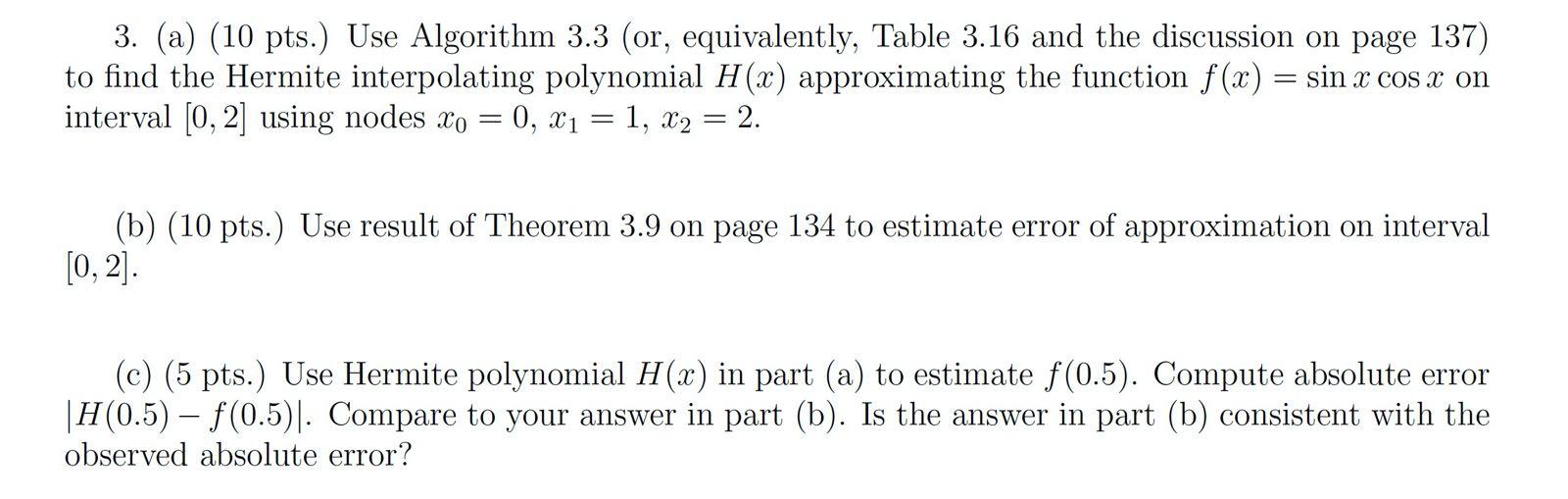
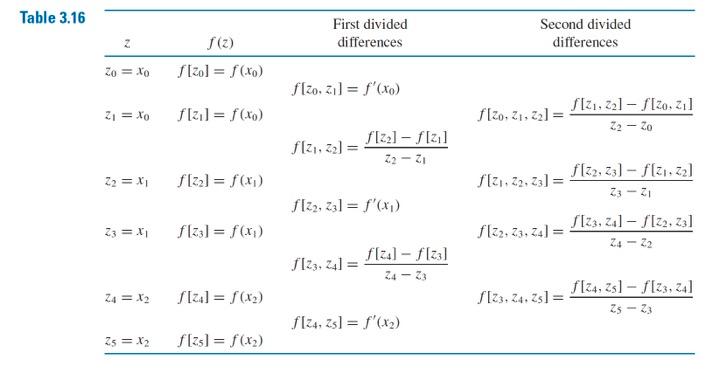
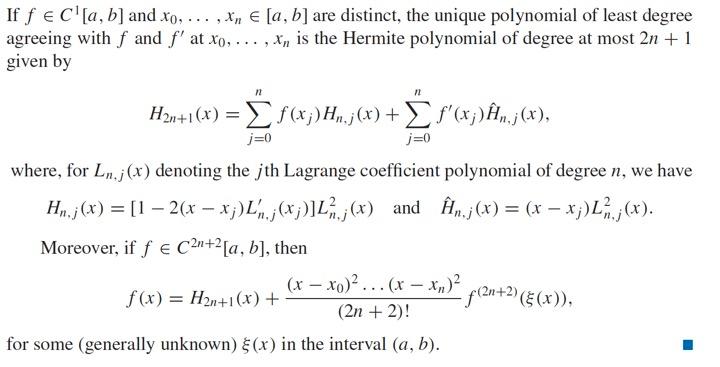
3. (a) (10 pts.) Use Algorithm 3.3 (or, equivalently, Table 3.16 and the discussion on page 137) to find the Hermite interpolating polynomial H(x) approximating the function f(x) = sin x cos x on interval (0, 2) using nodes Xo = 0, x1 = 1, X2 = 2. (b) (10 pts.) Use result of Theorem 3.9 on page 134 to estimate error of approximation on interval [0, 2]. (c) (5 pts.) Use Hermite polynomial H(x) in part (a) to estimate f(0.5). Compute absolute error |H(0.5) f(0.5)). Compare to your answer in part (b). Is the answer in part (b) consistent with the observed absolute error? Table 3.16 First divided differences Second divided differences (2) Zo = XO S[20] = f(x) f[zo, zil= f'(X) Z = Xo f(3) = f(x) f[20, 21, 221 = S[21,221 - S[zo zil 22 - 20 fiz, z2] = f[22] - [z] Z2-21 22 = X f[22] = f(x) f[3.22.23] = f[22,23] - f[21:22] Z3 - 21 f[22, 231 = f'(X) S[23, 24) - f[22, 231 Z3 = x1 f1z3) = f(x) f132, 33, 34) = f 123. 241 = f[zul - f123] f[24, 2s1 - f[33,241 Z4 = x2 S[:] = f(x2) [23.24.251 = $134,23] = f'(x2) Z5 = X2 f[35] = f (x2) If f EC'[a, b] and xo, ... , Xn [a, b] are distinct, the unique polynomial of least degree agreeing with f and f' at xo,. , X, is the Hermite polynomial of degree at most 2n + 1 given by n H2n+1(x) = f (x ;) H.;(x) + f'(x ;).j(x), j=0 j=0 where, for Ln.j(x) denoting the jth Lagrange coefficient polynomial of degree n, we have H.j(x) = [1 2(x xj)L, ;(X;)]L.j(x) and l,,j(x) = (x xj)L%.; (x). Moreover, if f C2n+2[a, b], then (x xo)? ... (x xn)? f/2n+2) (E(x)), f(x) = H2n+1(x) + (2n + 2)! for some (generally unknown) & (x) in the interval (a, b). 3. (a) (10 pts.) Use Algorithm 3.3 (or, equivalently, Table 3.16 and the discussion on page 137) to find the Hermite interpolating polynomial H(x) approximating the function f(x) = sin x cos x on interval (0, 2) using nodes Xo = 0, x1 = 1, X2 = 2. (b) (10 pts.) Use result of Theorem 3.9 on page 134 to estimate error of approximation on interval [0, 2]. (c) (5 pts.) Use Hermite polynomial H(x) in part (a) to estimate f(0.5). Compute absolute error |H(0.5) f(0.5)). Compare to your answer in part (b). Is the answer in part (b) consistent with the observed absolute error? Table 3.16 First divided differences Second divided differences (2) Zo = XO S[20] = f(x) f[zo, zil= f'(X) Z = Xo f(3) = f(x) f[20, 21, 221 = S[21,221 - S[zo zil 22 - 20 fiz, z2] = f[22] - [z] Z2-21 22 = X f[22] = f(x) f[3.22.23] = f[22,23] - f[21:22] Z3 - 21 f[22, 231 = f'(X) S[23, 24) - f[22, 231 Z3 = x1 f1z3) = f(x) f132, 33, 34) = f 123. 241 = f[zul - f123] f[24, 2s1 - f[33,241 Z4 = x2 S[:] = f(x2) [23.24.251 = $134,23] = f'(x2) Z5 = X2 f[35] = f (x2) If f EC'[a, b] and xo, ... , Xn [a, b] are distinct, the unique polynomial of least degree agreeing with f and f' at xo,. , X, is the Hermite polynomial of degree at most 2n + 1 given by n H2n+1(x) = f (x ;) H.;(x) + f'(x ;).j(x), j=0 j=0 where, for Ln.j(x) denoting the jth Lagrange coefficient polynomial of degree n, we have H.j(x) = [1 2(x xj)L, ;(X;)]L.j(x) and l,,j(x) = (x xj)L%.; (x). Moreover, if f C2n+2[a, b], then (x xo)? ... (x xn)? f/2n+2) (E(x)), f(x) = H2n+1(x) + (2n + 2)! for some (generally unknown) & (x) in the interval (a, b)
Step by Step Solution
There are 3 Steps involved in it

Get step-by-step solutions from verified subject matter experts
 Study Help