





Question: 3) A computer Company builds a gaming computer model ICU2, produces the Motherboard with inserts (Add-in Boards and DRAM) from Taiwan, each Motherboard requires 90
3) A computer Company builds a gaming computer3) A computer Company builds a gaming computer

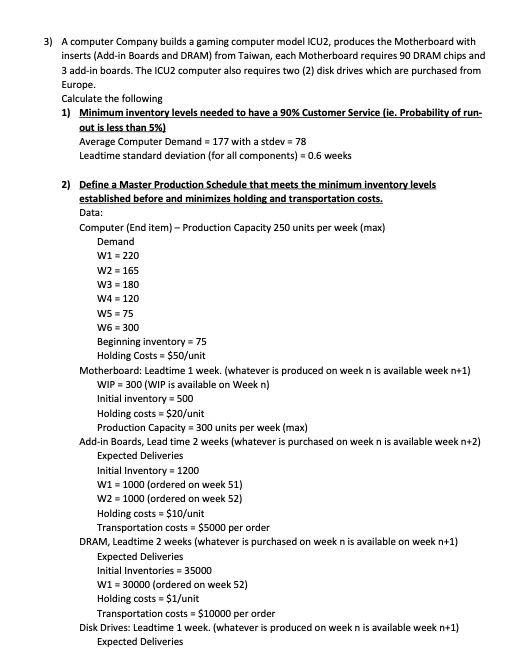
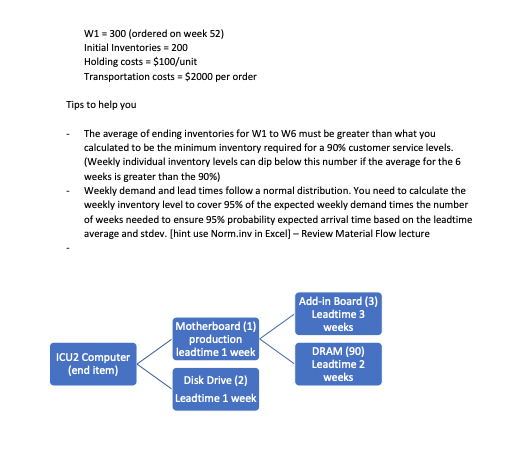
3) A computer Company builds a gaming computer model ICU2, produces the Motherboard with inserts (Add-in Boards and DRAM) from Taiwan, each Motherboard requires 90 DRAM chips and 3 add-in boards. The ICU2 computer also requires two (2) disk drives which are purchased from Europe Calculate the following 1) Minimum inventory levels needed to have a 90% Customer Service (ie. Probability of run- out is less than 5%) Average Computer Demand = 177 with a stdev = 78 Leadtime standard deviation (for all components) = 0.6 weeks 2) Define a Master Production Schedule that meets the minimum inventory levels established before and minimizes holding and transportation costs. Data: Computer (End item) - Production Capacity 250 units per week (max) Demand W1 = 220 W2 = 165 W3 = 180 W4 = 120 W575 W6 - 300 Beginning inventory = 75 Holding Costs = $50/unit Motherboard: Leadtime 1 week. (whatever is produced on week n is available week n+1) WIP = 300 (WIP is available on Week n) Initial inventory = 500 Holding costs = $20/unit Production Capacity = 300 units per week (max) Add-in Boards, Lead time 2 weeks (whatever is purchased on week n is available week n+2) Expected Deliveries Initial Inventory = 1200 W1 = 1000 (ordered on week 51) W2 = 1000 (ordered on week 52) Holding costs - $10/unit Transportation costs = $5000 per order DRAM, Leadtime 2 weeks (whatever is purchased on week n is available on week n+1) Expected Deliveries Initial Inventories - 35000 W1 = 30000 (ordered on week 52) Holding costs = $1/unit Transportation costs = $10000 per order Disk Drives: Leadtime 1 week. (whatever is produced on week n is available week n+1) Expected Deliveries W1 = 300 (ordered on week 52) Initial Inventories - 200 Holding costs = $100/unit Transportation costs = $2000 per order Tips to help you The average of ending inventories for W1 to W6 must be greater than what you calculated to be the minimum inventory required for a 90% customer service levels. (Weekly individual inventory levels can dip below this number if the average for the 6 weeks is greater than the 90%) Weekly demand and lead times follow a normal distribution. You need to calculate the weekly inventory level to cover 95% of the expected weekly demand times the number of weeks needed to ensure 95% probability expected arrival time based on the leadtime average and stdev. [hint use Norm.inc in Excel) Review Material Flow lecture Add-in Board (3) Leadtime 3 weeks DRAM (90) Leadtime 2 weeks Motherboard (1) production leadtime 1 week Disk Drive (2) Leadtime 1 week ICU2 Computer (end item) 3) A computer Company builds a gaming computer model ICU2, produces the Motherboard with inserts (Add-in Boards and DRAM) from Taiwan, each Motherboard requires 90 DRAM chips and 3 add-in boards. The ICU2 computer also requires two (2) disk drives which are purchased from Europe Calculate the following 1) Minimum inventory levels needed to have a 90% Customer Service (ie. Probability of run- out is less than 5%) Average Computer Demand = 177 with a stdev = 78 Leadtime standard deviation (for all components) = 0.6 weeks 2) Define a Master Production Schedule that meets the minimum inventory levels established before and minimizes holding and transportation costs. Data: Computer (End item) - Production Capacity 250 units per week (max) Demand W1 = 220 W2 = 165 W3 = 180 W4 = 120 W575 W6 - 300 Beginning inventory = 75 Holding Costs = $50/unit Motherboard: Leadtime 1 week. (whatever is produced on week n is available week n+1) WIP = 300 (WIP is available on Week n) Initial inventory = 500 Holding costs = $20/unit Production Capacity = 300 units per week (max) Add-in Boards, Lead time 2 weeks (whatever is purchased on week n is available week n+2) Expected Deliveries Initial Inventory = 1200 W1 = 1000 (ordered on week 51) W2 = 1000 (ordered on week 52) Holding costs - $10/unit Transportation costs = $5000 per order DRAM, Leadtime 2 weeks (whatever is purchased on week n is available on week n+1) Expected Deliveries Initial Inventories - 35000 W1 = 30000 (ordered on week 52) Holding costs = $1/unit Transportation costs = $10000 per order Disk Drives: Leadtime 1 week. (whatever is produced on week n is available week n+1) Expected Deliveries W1 = 300 (ordered on week 52) Initial Inventories - 200 Holding costs = $100/unit Transportation costs = $2000 per order Tips to help you The average of ending inventories for W1 to W6 must be greater than what you calculated to be the minimum inventory required for a 90% customer service levels. (Weekly individual inventory levels can dip below this number if the average for the 6 weeks is greater than the 90%) Weekly demand and lead times follow a normal distribution. You need to calculate the weekly inventory level to cover 95% of the expected weekly demand times the number of weeks needed to ensure 95% probability expected arrival time based on the leadtime average and stdev. [hint use Norm.inc in Excel) Review Material Flow lecture Add-in Board (3) Leadtime 3 weeks DRAM (90) Leadtime 2 weeks Motherboard (1) production leadtime 1 week Disk Drive (2) Leadtime 1 week ICU2 Computer (end item)

Step by Step Solution

There are 3 Steps involved in it

1 Expert Approved Answer
Step: 1 Unlock blur-text-image

Question Has Been Solved by an Expert!

Get step-by-step solutions from verified subject matter experts

Step: 2 Unlock
Step: 3 Unlock

Students Have Also Explored These Related General Management Questions!