







Question: 3. A diffraction trace for face centred cubic (fcc) cobalt metal contains diffraction peaks as listed in Table 1: Angle to directly transmitted X-
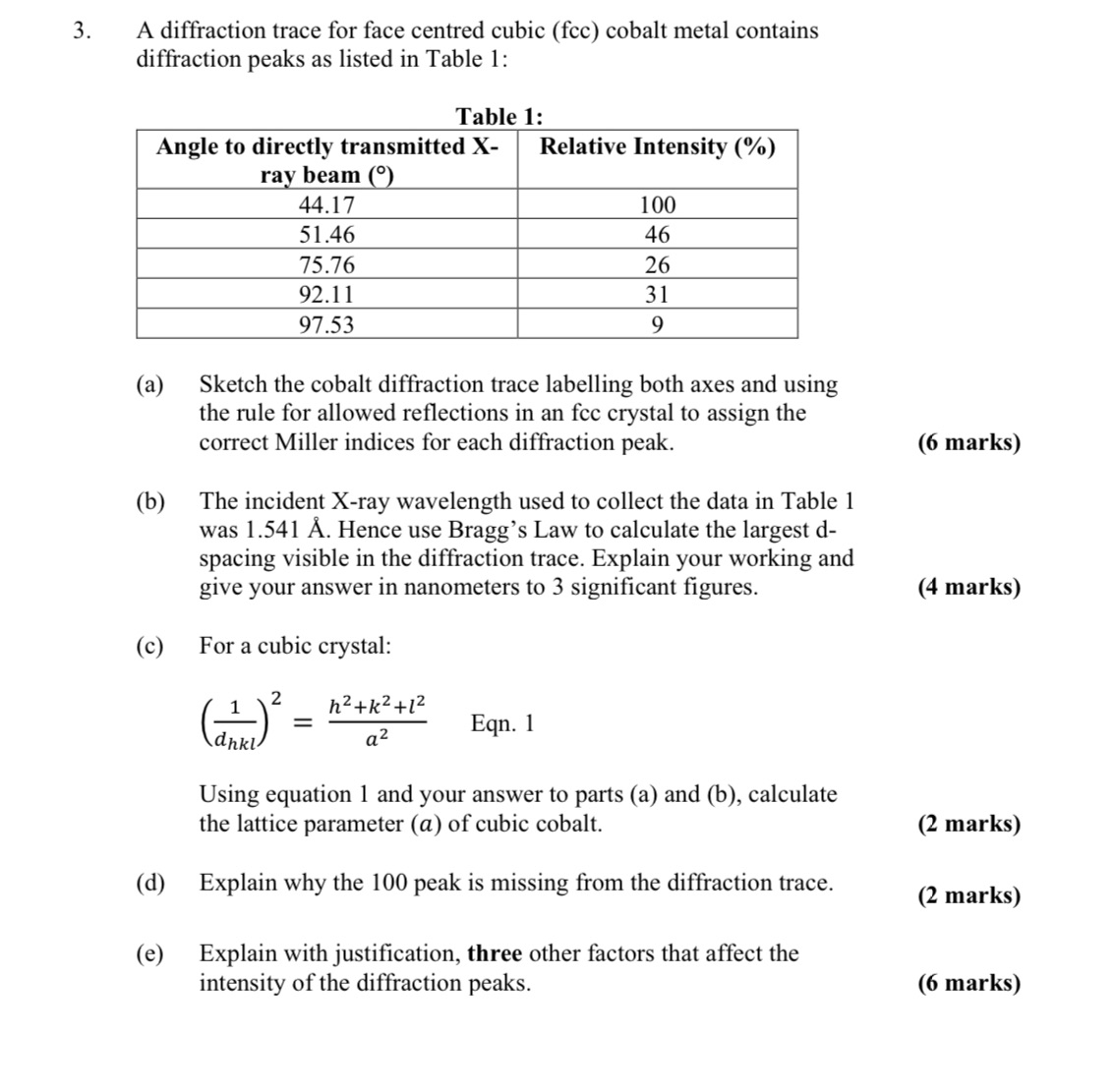
3. A diffraction trace for face centred cubic (fcc) cobalt metal contains diffraction peaks as listed in Table 1: Angle to directly transmitted X- Table 1: Relative Intensity (%) ray beam (9) 44.17 100 51.46 46 75.76 26 92.11 31 97.53 9 (a) Sketch the cobalt diffraction trace labelling both axes and using the rule for allowed reflections in an fcc crystal to assign the correct Miller indices for each diffraction peak. (6 marks) (b) The incident X-ray wavelength used to collect the data in Table 1 was 1.541 . Hence use Bragg's Law to calculate the largest d- spacing visible in the diffraction trace. Explain your working and give your answer in nanometers to 3 significant figures. (4 marks) (c) For a cubic crystal: 2 h+k+1 = dhkl a Eqn. 1 Using equation 1 and your answer to parts (a) and (b), calculate the lattice parameter (a) of cubic cobalt. (2 marks) (d) Explain why the 100 peak is missing from the diffraction trace. (2 marks) (e) Explain with justification, three other factors that affect the intensity of the diffraction peaks. (6 marks)
Step by Step Solution
There are 3 Steps involved in it

Get step-by-step solutions from verified subject matter experts
 Study Help