







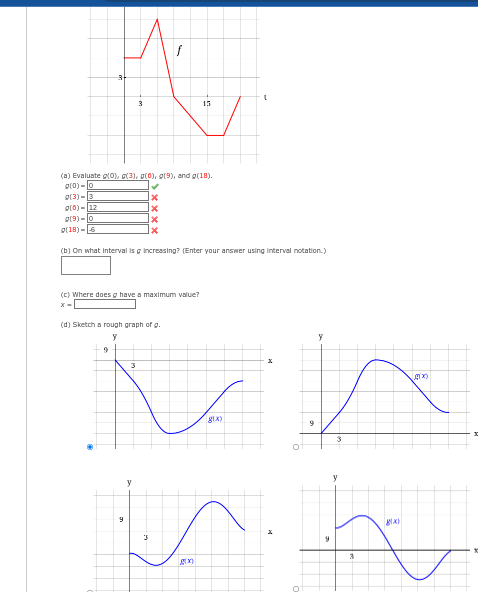
Question: 3 (a) Evaluate #10) (3], 8(0), 9[9), and a(18). 013) - 3 g(0) - 12 0[18) -6 (b] On what Interval is @ Increasing? (Enter
![3 (a) Evaluate #10) (3], 8(0), 9[9), and a(18). 013) -](https://s3.amazonaws.com/si.experts.images/answers/2024/06/66650f582b4b8_09666650f5812e22.jpg)
![3 g(0) - 12 0[18) -6 (b] On what Interval is @](https://s3.amazonaws.com/si.experts.images/answers/2024/06/66650f5876aed_09666650f5862557.jpg)
![a maximum value? (d] Sketch a rough graph of g. 3 9](https://s3.amazonaws.com/si.experts.images/answers/2024/06/66650f590f9c1_09666650f58eef42.jpg)
3 (a) Evaluate #10) (3], 8(0), 9[9), and a(18). 013) - 3 g(0) - 12 0[18) -6 (b] On what Interval is @ Increasing? (Enter your answer using Interval notation.) (c) Where does @ have a maximum value? (d] Sketch a rough graph of g. 3 9 3 4Let g(x) = At) at, where f is the function whose graph is shown. 2 1 10 20 30 40 -1 -31 (a) At what values of x do the local maximum and minimum values of g occur? *min = 15 (smaller x-value) *min = 35 (larger x-value) Xmax = 25 X (smaller x-value) max = 45 x (larger x-value) (b) Where does q attain its absolute maximum value? X = [15 X (c) On what interval is g concave downward? (Enter your answer using interval notation.)
Step by Step Solution
There are 3 Steps involved in it

Get step-by-step solutions from verified subject matter experts
 Study Help