







Question: 3. A fermentation process for an antibiotic is to be transferred from the pilot plant to production using a constant kia as scale-up criterion. (20
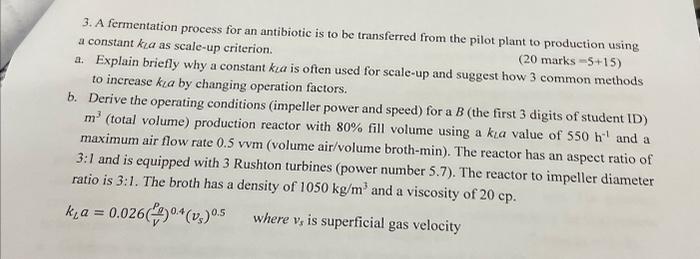
3. A fermentation process for an antibiotic is to be transferred from the pilot plant to production using a constant ka as scale-up criterion. a. Explain briefly why a constant k ia is often used for seale-up and suggest how 3 common methods to increase k a by changing operation factors. b. Derive the operating conditions (impeller power and speed) for a B (the first 3 digits of student ID) m3 (total volume) production reactor with 80% fill volume using a kLa value of 550h1 and a maximum air flow rate 0.5vvm (volume air/volume broth-min). The reactor has an aspect ratio of 3:1 and is equipped with 3 Rushton turbines (power number 5.7). The reactor to impeller diameter ratio is 3:1. The broth has a density of 1050kg/m3 and a viscosity of 20cp. kLa=0.026(VPg)0.4(vs)0.5 where vs is superficial gas velocity
Step by Step Solution
There are 3 Steps involved in it

Get step-by-step solutions from verified subject matter experts
 Study Help