







Question: 3. (a) Let a = 0, b = 1. Compute the weights of the interpolatory quadrature formula I with the nodes 2o = 0, 11
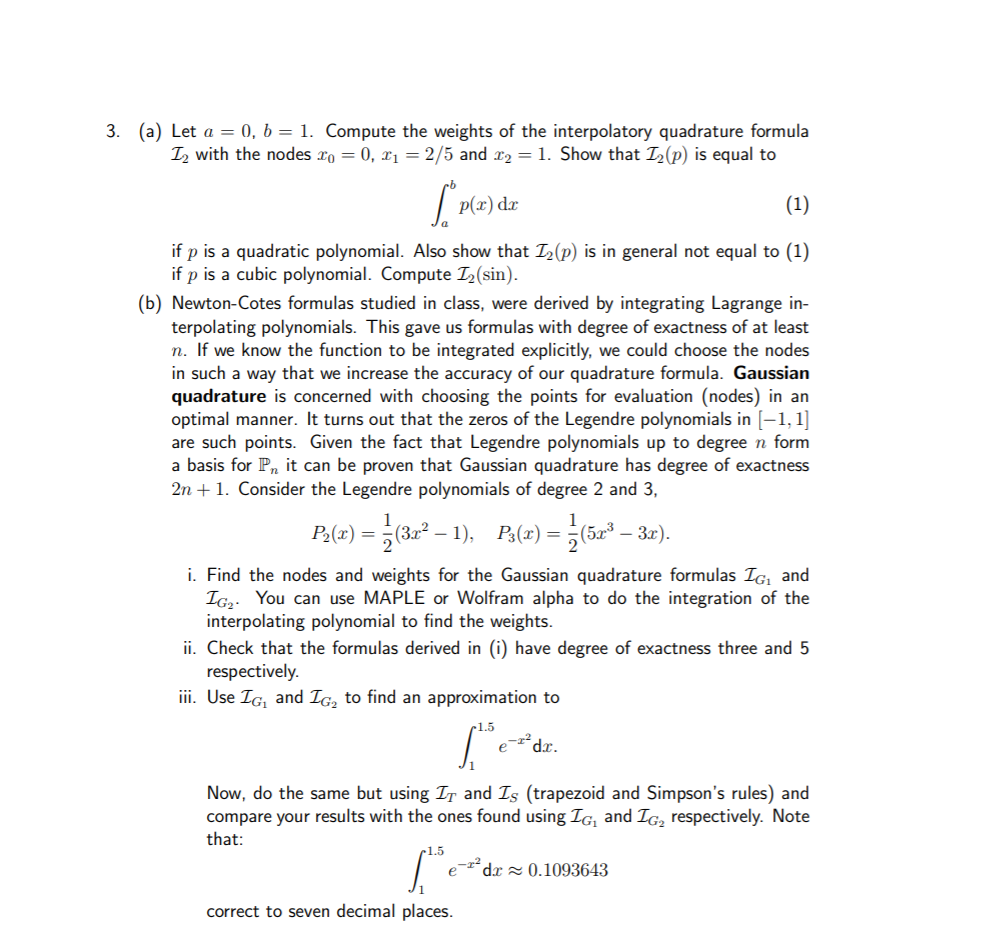
3. (a) Let a = 0, b = 1. Compute the weights of the interpolatory quadrature formula I with the nodes 2o = 0, 11 = 2/5 and 22 = 1. Show that I (p) is equal to | p(x) dr (1) if p is a quadratic polynomial. Also show that L2 (p) is in general not equal to (1) if p is a cubic polynomial. Compute L2 (sin). (b) Newton-Cotes formulas studied in class, were derived by integrating Lagrange in- terpolating polynomials. This gave us formulas with degree of exactness of at least n. If we know the function to be integrated explicitly, we could choose the nodes in such a way that we increase the accuracy of our quadrature formula. Gaussian quadrature is concerned with choosing the points for evaluation (nodes) in an optimal manner. It turns out that the zeros of the Legendre polynomials in (-1,1] are such points. Given the fact that Legendre polynomials up to degree n form a basis for Pn it can be proven that Gaussian quadrature has degree of exactness 2n + 1. Consider the Legendre polynomials of degree 2 and 3, Pz(x) = 5(37 1), P3(x) = 5(52? 31). i. Find the nodes and weights for the Gaussian quadrature formulas IG, and IG,. You can use MAPLE or Wolfram alpha to do the integration of the interpolating polynomial to find the weights. ii. Check that the formulas derived in (i) have degree of exactness three and 5 respectively. iii. Use IG, and LG, to find an approximation to 1.5 e-dr. Now, do the same but using It and Is (trapezoid and Simpson's rules) and compare your results with the ones found using IG, and IG, respectively. Note that: | e-dx 0.1093643 1.5 correct to seven decimal places. 3. (a) Let a = 0, b = 1. Compute the weights of the interpolatory quadrature formula I with the nodes 2o = 0, 11 = 2/5 and 22 = 1. Show that I (p) is equal to | p(x) dr (1) if p is a quadratic polynomial. Also show that L2 (p) is in general not equal to (1) if p is a cubic polynomial. Compute L2 (sin). (b) Newton-Cotes formulas studied in class, were derived by integrating Lagrange in- terpolating polynomials. This gave us formulas with degree of exactness of at least n. If we know the function to be integrated explicitly, we could choose the nodes in such a way that we increase the accuracy of our quadrature formula. Gaussian quadrature is concerned with choosing the points for evaluation (nodes) in an optimal manner. It turns out that the zeros of the Legendre polynomials in (-1,1] are such points. Given the fact that Legendre polynomials up to degree n form a basis for Pn it can be proven that Gaussian quadrature has degree of exactness 2n + 1. Consider the Legendre polynomials of degree 2 and 3, Pz(x) = 5(37 1), P3(x) = 5(52? 31). i. Find the nodes and weights for the Gaussian quadrature formulas IG, and IG,. You can use MAPLE or Wolfram alpha to do the integration of the interpolating polynomial to find the weights. ii. Check that the formulas derived in (i) have degree of exactness three and 5 respectively. iii. Use IG, and LG, to find an approximation to 1.5 e-dr. Now, do the same but using It and Is (trapezoid and Simpson's rules) and compare your results with the ones found using IG, and IG, respectively. Note that: | e-dx 0.1093643 1.5 correct to seven decimal places
Step by Step Solution
There are 3 Steps involved in it

Get step-by-step solutions from verified subject matter experts
 Study Help