







Question: 3. A parent has two children named A and B and she loves both of them equally. She has a total of $1,000 to give
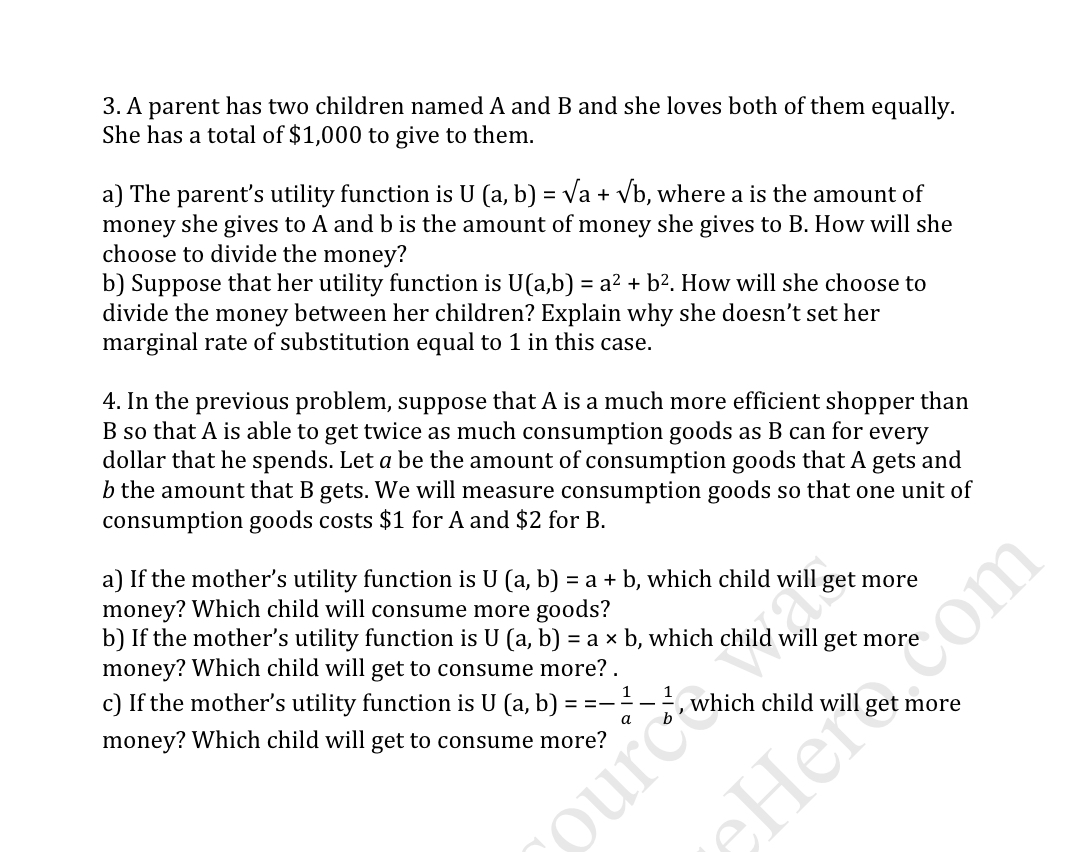
3. A parent has two children named A and B and she loves both of them equally. She has a total of $1,000 to give to them. a] The parent's utility function is U (a, b] = J a + V'b, where a is the amount of money she gives to A and b is the amount of money she gives to B. How will she choose to divide the money? b) Suppose that her utility function is U[a,b) = a2 + b2. How will she choose to divide the money between her children? Explain why she doesn't set her marginal rate of substitution equal to 1 in this case. 4. In the previous problem, suppose thatA is a much more efcient shopper than B so thatA is able to get twice as much consumption goods as B can for every dollar that he spends. Let a be the amount of consumption goods that A gets and b the amount that B gets. We will measure consumption goods so that one unit of consumption goods costs $1 forA and $2 for B. a] If the mother's utility function is U (a, b) = a + b, which child will get more money? Which child will consume more goods? b) If the mother's utility function is U (a, b] = a x b, which child will get more money? Which child will get to consume more? . c) If the mother's utility function is U (a, b) = = l i, which child will get more a money? Which child will get to consume more
Step by Step Solution
There are 3 Steps involved in it

Get step-by-step solutions from verified subject matter experts
 Study Help