



Question: 3. A particle moves under a simple-harmonic force law F() = -52. starting at x = 0. Due to the competing effect of friction, the
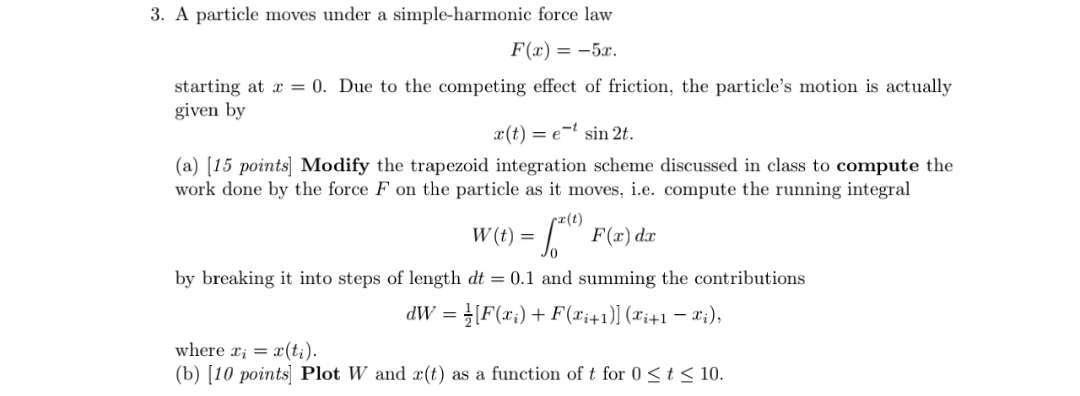
3. A particle moves under a simple-harmonic force law F() = -52. starting at x = 0. Due to the competing effect of friction, the particle's motion is actually given by (t) = e- sin 2t. (a) (15 points] Modify the trapezoid integration scheme discussed in class to compute the work done by the force F on the particle as it moves, i.e. compute the running integral W(t) = S.*" f(x) de by breaking it into steps of length dt = 0.1 and summing the contributions DW = }(F(xi) + F((i+1)] (xi +1 = x;), where x; = x(ti). (b) (10 points Plot W and (t) as a function of t for 0
Step by Step Solution
There are 3 Steps involved in it
1 Expert Approved Answer
Step: 1 Unlock

Question Has Been Solved by an Expert!
Get step-by-step solutions from verified subject matter experts
Step: 2 Unlock
Step: 3 Unlock