







Question: 3. A policyholder, whose current age is , just makes a 3-year deferred, 2-year term life insurance contract with the death benefit amount $30,000. The
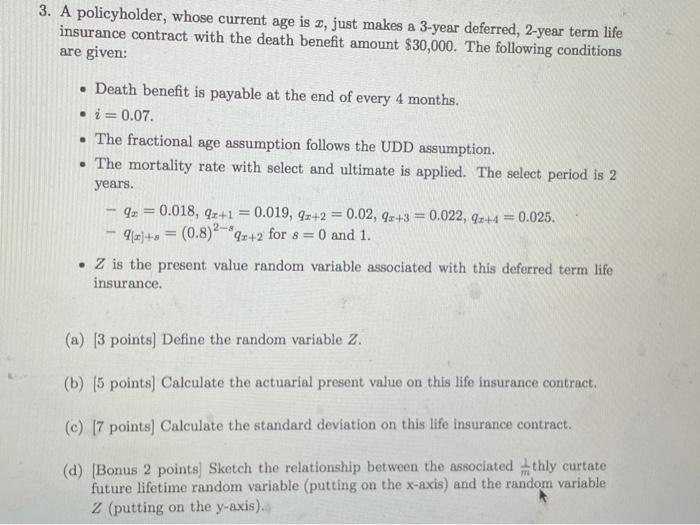
3. A policyholder, whose current age is , just makes a 3-year deferred, 2-year term life insurance contract with the death benefit amount $30,000. The following conditions are given: Death benefit is payable at the end of every 4 months. . i=0.07. The fractional age assumption follows the UDD assumption. The mortality rate with select and ultimate is applied. The select period is 2 years. qu=0.018, 9z+1 = 0.019, 41+2=0.02, 93+3 = 0.022, 2x+4 = 0.025. 9:11+0 = (0.8)2-49+2 for 8 = = 0 and 1. . Z is the present value random variable associated with this deferred term life insurance. (a) (3 points) Define the random variable 2. (b) (5 points) Calculate the actuarial present value on this life insurance contract. (c) 17 points) Calculate the standard deviation on this life insurance contract. (d) (Bonus 2 points) Sketch the relationship between the associated thly curtato future lifetime random variable (putting on the x-axis) and the random variable 2 (putting on the y-axis). 3. A policyholder, whose current age is , just makes a 3-year deferred, 2-year term life insurance contract with the death benefit amount $30,000. The following conditions are given: Death benefit is payable at the end of every 4 months. . i=0.07. The fractional age assumption follows the UDD assumption. The mortality rate with select and ultimate is applied. The select period is 2 years. qu=0.018, 9z+1 = 0.019, 41+2=0.02, 93+3 = 0.022, 2x+4 = 0.025. 9:11+0 = (0.8)2-49+2 for 8 = = 0 and 1. . Z is the present value random variable associated with this deferred term life insurance. (a) (3 points) Define the random variable 2. (b) (5 points) Calculate the actuarial present value on this life insurance contract. (c) 17 points) Calculate the standard deviation on this life insurance contract. (d) (Bonus 2 points) Sketch the relationship between the associated thly curtato future lifetime random variable (putting on the x-axis) and the random variable 2 (putting on the y-axis)
Step by Step Solution
There are 3 Steps involved in it

Get step-by-step solutions from verified subject matter experts
 Study Help