







Question: 3. A source transmits data packets to a receiver over a radio link. The receiver uses error detection to identify packets that have been corrupted
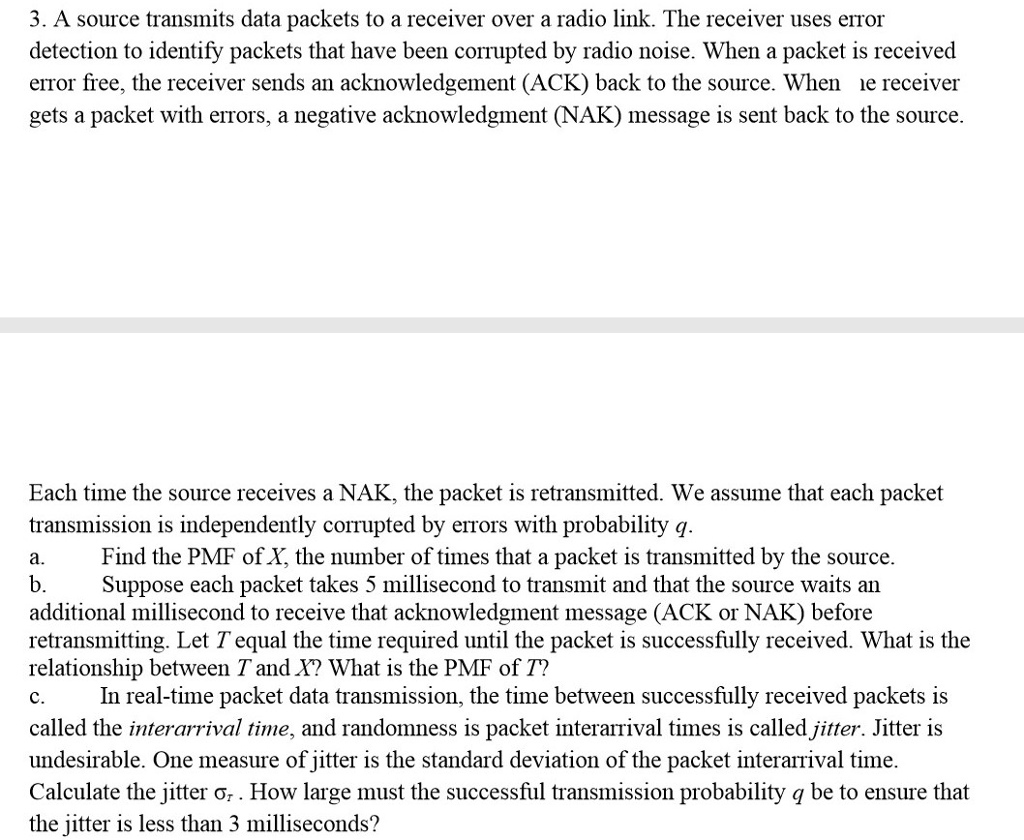
3. A source transmits data packets to a receiver over a radio link. The receiver uses error detection to identify packets that have been corrupted by radio noise. When a packet is received error free, the receiver sends an acknowledgement (ACK) back to the source. When ie receiver gets a packet with errors, a negative acknowledgment (NAK) message is sent back to the source Each time the source receives a NAK, the packet is retransmitted. We assume that each packet transmission is independently corrupted by errors with probability q a. Find the PMF of X, the number of times that a packet is transmitted by the source. Suppose each packet takes 5 millisecond to transmit and that the source waits an additional millisecond to receive that acknowledgment message (ACK or NAK) before retransmitting. Let T equal the time required until the packet is successfully received. What is the relationship between Tand X? What is the PMF of T? C. called the interarrival time, and randomness is packet interarrival times is called jitter. Jitter is undesirable. One measure of jitter is the standard deviation of the packet interarrival time. Calculate the jitter . How large must the successful transmission probability q be to ensure that the jitter is less than 3 milliseconds? In real-time packet data transmission, the time between successfully received packets is
Step by Step Solution
There are 3 Steps involved in it

Get step-by-step solutions from verified subject matter experts
 Study Help