







Question: (3) A statement as to whether this bonus is considered a direct labor cost or a factory overhead item and its position on the income
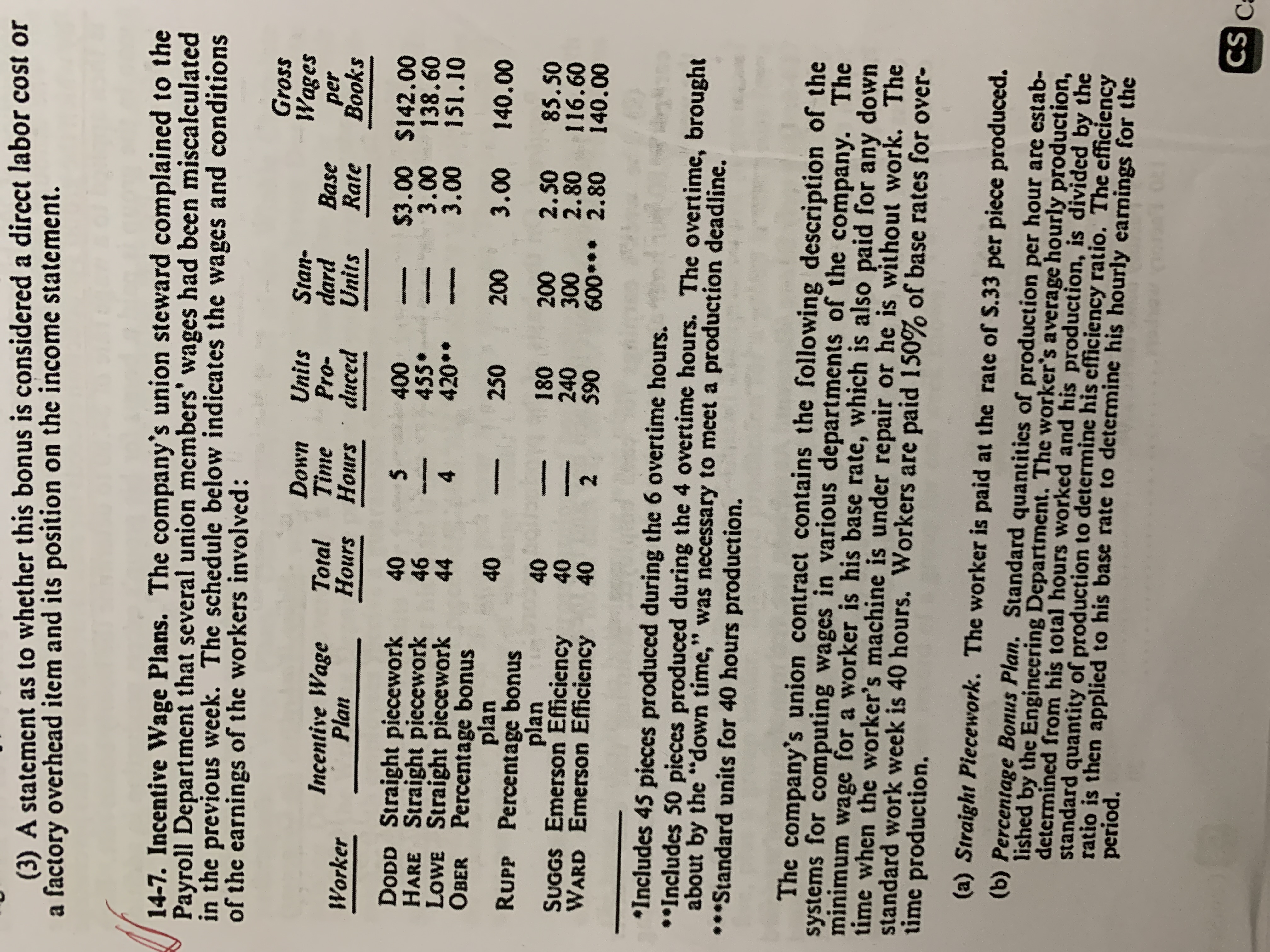
(3) A statement as to whether this bonus is considered a direct labor cost or a factory overhead item and its position on the income statement. 14-7. Incentive Wage Plans. The company's union steward complained to the Payroll Department that several union members' wages had been miscalculated in the previous week. The schedule below indicates the wages and conditions of the earnings of the workers involved: Gross Down Units Stan- Wages Incentive Wage Total Time Pro- dard Base per Worker Plan Hours Hours duced Units Rate Books DODD Straight piecework 40 5 400 $3.00 $142.00 HARE Straight piecework 46 455. 3.00 138.60 LOWE Straight piecework 44 420. 3.00 151. 10 OBER Percentage bonus plan 40 250 200 3.00 140.00 RUPP Percentage bonus plan 40 180 200 2.50 85.50 SUGGS Emerson Efficiency 40 240 300 2.80 116.60 N WARD Emerson Efficiency 40 590 600* * * 2.80 140.00 *Includes 45 pieces produced during the 6 overtime hours. .Includes 50 pieces produced during the 4 overtime hours. The overtime, brought about by the "down time," was necessary to meet a production deadline. . * *Standard units for 40 hours production. The company's union contract contains the following description of the systems for computing wages in various departments of the company. The minimum wage for a worker is his base rate, which is also paid for any down time when the worker's machine is under repair or he is without work. The standard work week is 40 hours. Workers are paid 150% of base rates for over- time production. (a) Straight Piecework. The worker is paid at the rate of $.33 per piece produced. (b) Percentage Bonus Plan. Standard quantities of production per hour are estab- lished by the Engineering Department. The worker's average hourly production, determined from his total hours worked and his production, is divided by the standard quantity of production to determine his efficiency ratio. The efficiency period. ratio is then applied to his base rate to determine his hourly earnings for the CS
Step by Step Solution
There are 3 Steps involved in it

Get step-by-step solutions from verified subject matter experts
 Study Help