







Question: 3. A student must do a problem set, but can do it in any one of the three periods = 1,2, 3. The immediate utility
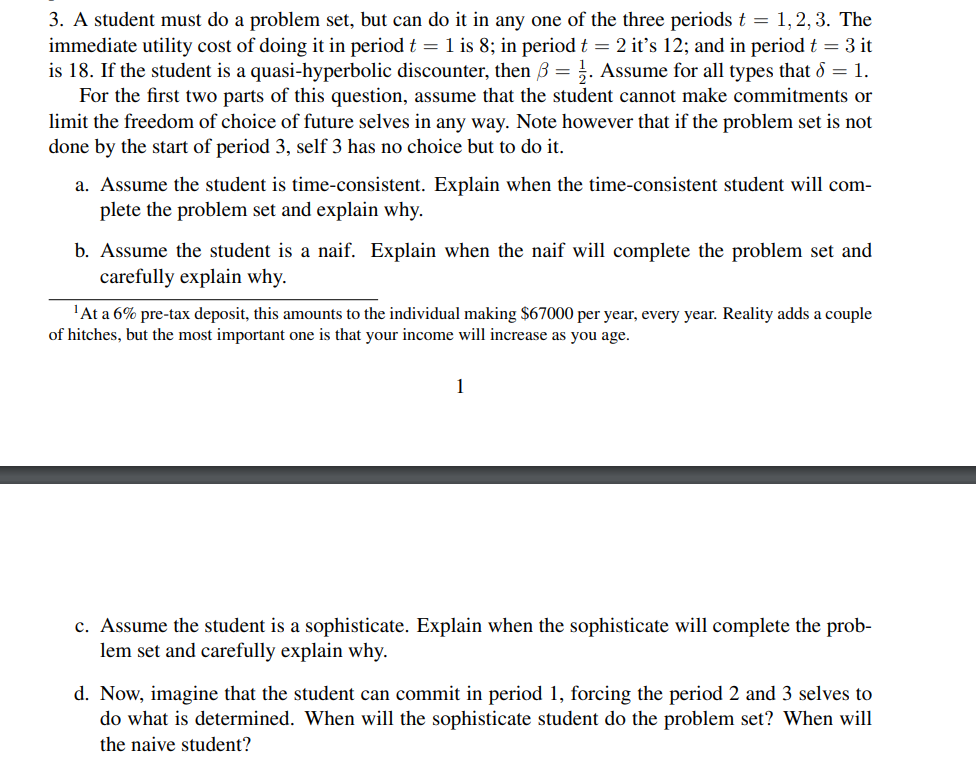
3. A student must do a problem set, but can do it in any one of the three periods = 1,2, 3. The immediate utility cost of doing itin period = 1is 8; in period = 2it's 12; and in period { = 3 it is 18. If the student is a quasi-hyperbolic discounter, then 3 = '1:3 Assume for all types that = 1. For the first two parts of this question, assume that the student cannot make commitments or limit the freedom of choice of future selves in any way. Note however that if the problem set is not done by the start of period 3, self 3 has no choice but to do it. a. Assume the student is time-consistent. Explain when the time-consistent student will com- plete the problem set and explain why. b. Assume the student is a naif. Explain when the naif will complete the problem set and carefully explain why. 'At a 6% pre-tax deposit, this amounts to the individual making $67000 per year, every year. Reality adds a couple of hitches, but the most important one is that your income will increase as you age. c. Assume the student is a sophisticate. Explain when the sophisticate will complete the prob- lem set and carefully explain why. d. Now, imagine that the student can commit in period 1, forcing the period 2 and 3 selves to do what is determined. When will the sophisticate student do the problem set? When will the naive student
Step by Step Solution
There are 3 Steps involved in it

Get step-by-step solutions from verified subject matter experts
 Study Help