







Question: 3) a) Use Simpson's 3/8th Rule with 7 points to estimate I =dx. 1 2 3 4 () 2 12 36 80 +x (Leave
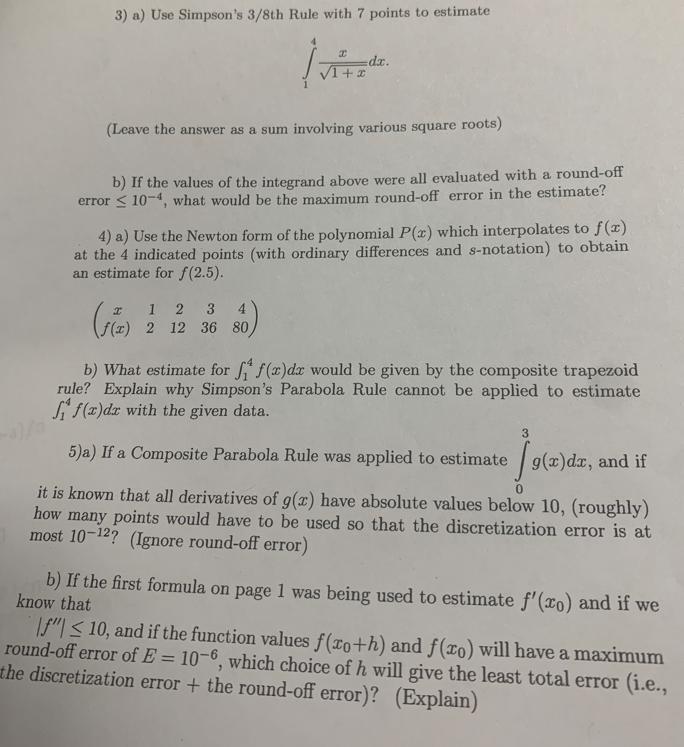
3) a) Use Simpson's 3/8th Rule with 7 points to estimate I =dx. 1 2 3 4 () 2 12 36 80 +x (Leave the answer as a sum involving various square roots) b) If the values of the integrand above were all evaluated with a round-off error 10-4, what would be the maximum round-off error in the estimate? 4) a) Use the Newton form of the polynomial P(x) which interpolates to f(x) at the 4 indicated points (with ordinary differences and s-notation) to obtain an estimate for f(2.5). b) What estimate for fi f(x)dx would be given by the composite trapezoid rule? Explain why Simpson's Parabola Rule cannot be applied to estimate if(x)dx with the given data. 3 5)a) If a Composite Parabola Rule was applied to estimate [9(z)dz, and if it is known that all derivatives of g(x) have absolute values below 10, (roughly) how many points would have to be used so that the discretization error is at most 10-12? (Ignore round-off error) b) If the first formula on page 1 was being used to estimate f'(xo) and if we know that If" 10, and if the function values f(xo+h) and f(xo) will have a maximum round-off error of E= 10-6, which choice of h will give the least total error (i.e., the discretization error + the round-off error)? (Explain)
Step by Step Solution
3.54 Rating (147 Votes )
There are 3 Steps involved in it
x Let fx VITE x Here step size is h 41 71 o 1 x1 15 x2 2 x3 25 x4 3 x5 35 x6 4 Let fi fx ... View full answer

Get step-by-step solutions from verified subject matter experts
 Study Help