







Question: 3. An elementary school teacher needs to generate mathematical problems to pupils. This week's problem is about counting if the first two baskets have
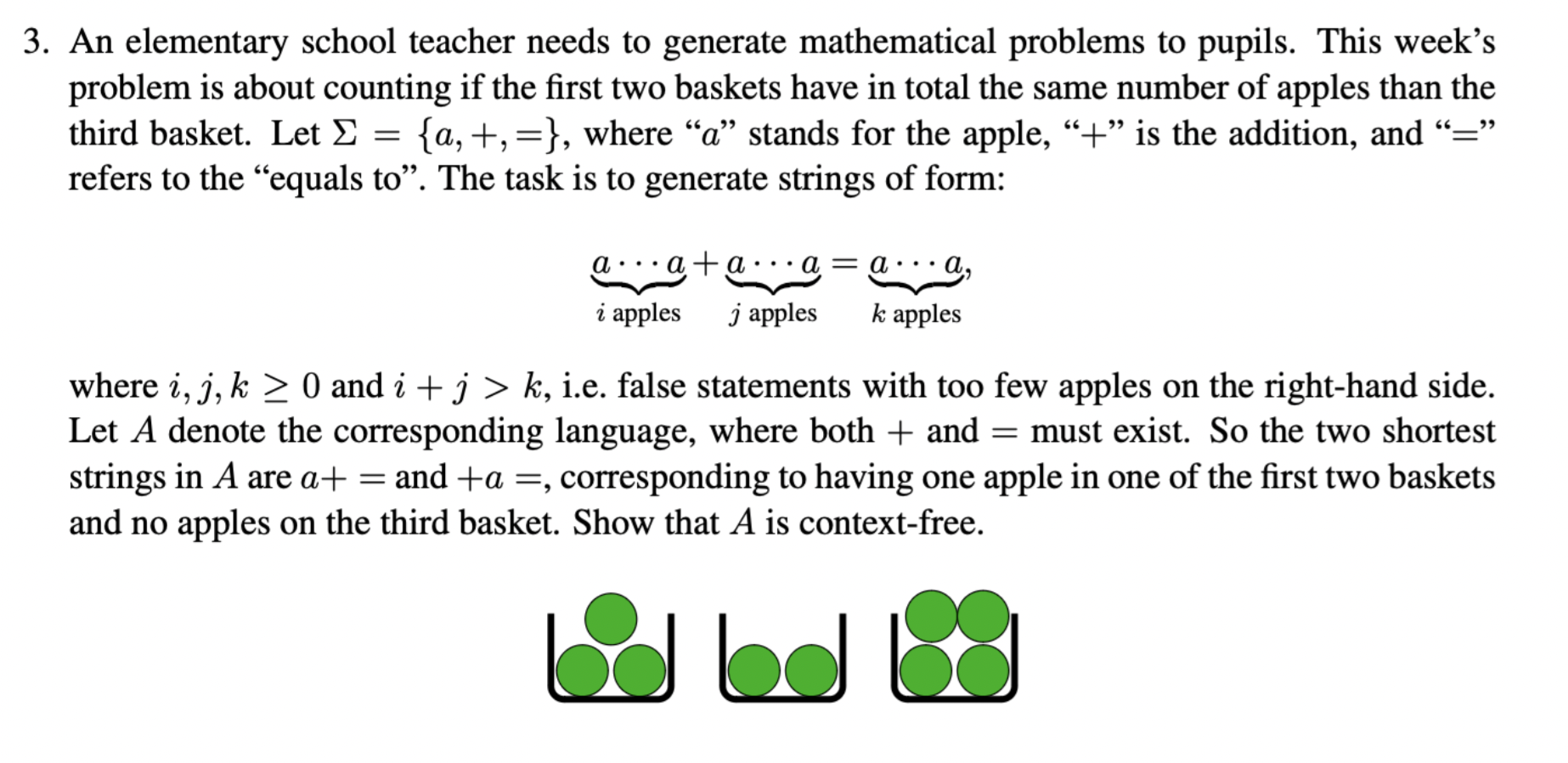
3. An elementary school teacher needs to generate mathematical problems to pupils. This week's problem is about counting if the first two baskets have in total the same number of apples than the third basket. Let = {a, +, =}, where a stands for the apple, + is the addition, and = refers to the "equals to". The task is to generate strings of form: a. a+a ...a = a. ...a i apples j apples k apples where i, j, k 0 and i + j> k, i.e. false statements with too few apples on the right-hand side. Let A denote the corresponding language, where both + and = must exist. So the two shortest strings in A are a+ = and +a =, corresponding to having one apple in one of the first two baskets and no apples on the third basket. Show that A is context-free. bd
Step by Step Solution
There are 3 Steps involved in it
To show that language A is contextfree we can construct a contextfree grammar CFG that generates all ... View full answer

Get step-by-step solutions from verified subject matter experts
 Study Help