







Question: 3. An input x(n) goes through a linear time invariant system with an impulse response h(n) given as h(n) = 0.75[u(n) - u(n-1019)] and x(n)
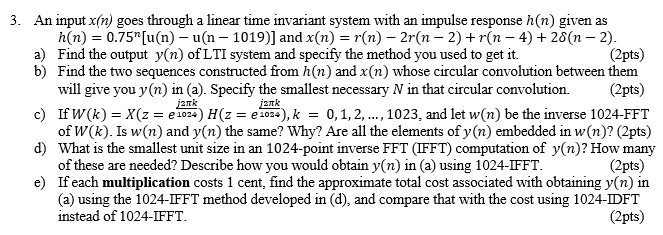
3. An input x(n) goes through a linear time invariant system with an impulse response h(n) given as h(n) = 0.75"[u(n) - u(n-1019)] and x(n) = r(n) - 2r(n-2) +r(n - 4) + 28(n-2). a) Find the output y(n) of LTI system and specify the method you used to get it. (2pts) b) Find the two sequences constructed from h(n) and x(n) whose circular convolution between them will give you y(n) in (a). Specify the smallest necessary N in that circular convolution. (2pts) c) IfW(k) = X(z = 21038) H(z = 22034), k = 0,1, 2, ..., 1023, and let w(n) be the inverse 1024-FFT of W(k). Is w(n) and y(n) the same? Why? Are all the elements of y(n) embedded in w(n)? (2pts) d) What is the smallest unit size in an 1024-point inverse FFT (IFFT) computation of y(n)? How many of these are needed? Describe how you would obtain y(n) in (a) using 1024-IFFT. (2pts) e) If each multiplication costs 1 cent, find the approximate total cost associated with obtaining y(n) in (a) using the 1024-IFFT method developed in (d), and compare that with the cost using 1024-IDFT instead of 1024-IFFT. (2pts) 3. An input x(n) goes through a linear time invariant system with an impulse response h(n) given as h(n) = 0.75"[u(n) - u(n-1019)] and x(n) = r(n) - 2r(n-2) +r(n - 4) + 28(n-2). a) Find the output y(n) of LTI system and specify the method you used to get it. (2pts) b) Find the two sequences constructed from h(n) and x(n) whose circular convolution between them will give you y(n) in (a). Specify the smallest necessary N in that circular convolution. (2pts) c) IfW(k) = X(z = 21038) H(z = 22034), k = 0,1, 2, ..., 1023, and let w(n) be the inverse 1024-FFT of W(k). Is w(n) and y(n) the same? Why? Are all the elements of y(n) embedded in w(n)? (2pts) d) What is the smallest unit size in an 1024-point inverse FFT (IFFT) computation of y(n)? How many of these are needed? Describe how you would obtain y(n) in (a) using 1024-IFFT. (2pts) e) If each multiplication costs 1 cent, find the approximate total cost associated with obtaining y(n) in (a) using the 1024-IFFT method developed in (d), and compare that with the cost using 1024-IDFT instead of 1024-IFFT. (2pts)
Step by Step Solution
There are 3 Steps involved in it

Get step-by-step solutions from verified subject matter experts
 Study Help