







Question: 3. Answer Alut parta. (a) Explain the sfendy-state approximation with the aid of a sabelled aketch. (b) The oxidation of NO to NO, has the
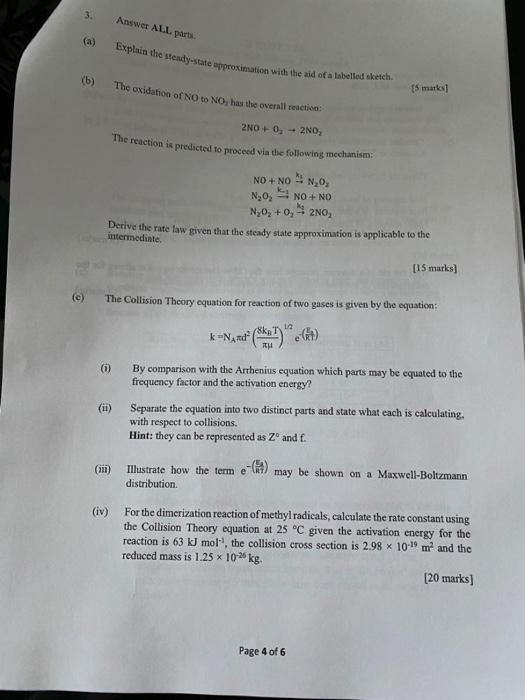
3. Answer Alut parta. (a) Explain the sfendy-state approximation with the aid of a sabelled aketch. (b) The oxidation of NO to NO, has the overall teaction: [5 matke] 2NO+O2+2NO2 The reaction is predicted to procecd via the following mechanism: NO+NO4k1N2O2N2O2k2NO2+NON2O2+O22NO2 Derive the rate law given that the steady state approximation ts applicable to the intermediate. [15 marks] (c) The Collision Theory equation for raction of two gases is given by the equation: k=NAd2(8kBT)1/2e(kTE2) (i) By comparison with the Arthenius equation which parts may be equated to the frequency factor and the activation energy? (ii) Separate the equation into two distinct parts and state what each is calculating, with respect to collisions. Hint: they can be represented as Z and f. (iii) Illustrate how the term e(krE0) may be shown on a Maxwell-Boltzmann distribution. (iv) For the dimerization reaction of methyl radicals, calculate the rate constant using the Collision Theory equation at 25C given the activation energy for the reaction is 63kJmol1, the collision cross section is 2.981019m2 and the reduced mass is 1.251026kg. [20 marks] 3. Answer Alut parta. (a) Explain the sfendy-state approximation with the aid of a sabelled aketch. (b) The oxidation of NO to NO, has the overall teaction: [5 matke] 2NO+O2+2NO2 The reaction is predicted to procecd via the following mechanism: NO+NO4k1N2O2N2O2k2NO2+NON2O2+O22NO2 Derive the rate law given that the steady state approximation ts applicable to the intermediate. [15 marks] (c) The Collision Theory equation for raction of two gases is given by the equation: k=NAd2(8kBT)1/2e(kTE2) (i) By comparison with the Arthenius equation which parts may be equated to the frequency factor and the activation energy? (ii) Separate the equation into two distinct parts and state what each is calculating, with respect to collisions. Hint: they can be represented as Z and f. (iii) Illustrate how the term e(krE0) may be shown on a Maxwell-Boltzmann distribution. (iv) For the dimerization reaction of methyl radicals, calculate the rate constant using the Collision Theory equation at 25C given the activation energy for the reaction is 63kJmol1, the collision cross section is 2.981019m2 and the reduced mass is 1.251026kg. [20 marks]
Step by Step Solution
There are 3 Steps involved in it

Get step-by-step solutions from verified subject matter experts
 Study Help