







Question: 3. Answer the following questions based on the data below under the assumptions of the Heckscher-Ohlin model. Note that the data describe a Leontief production
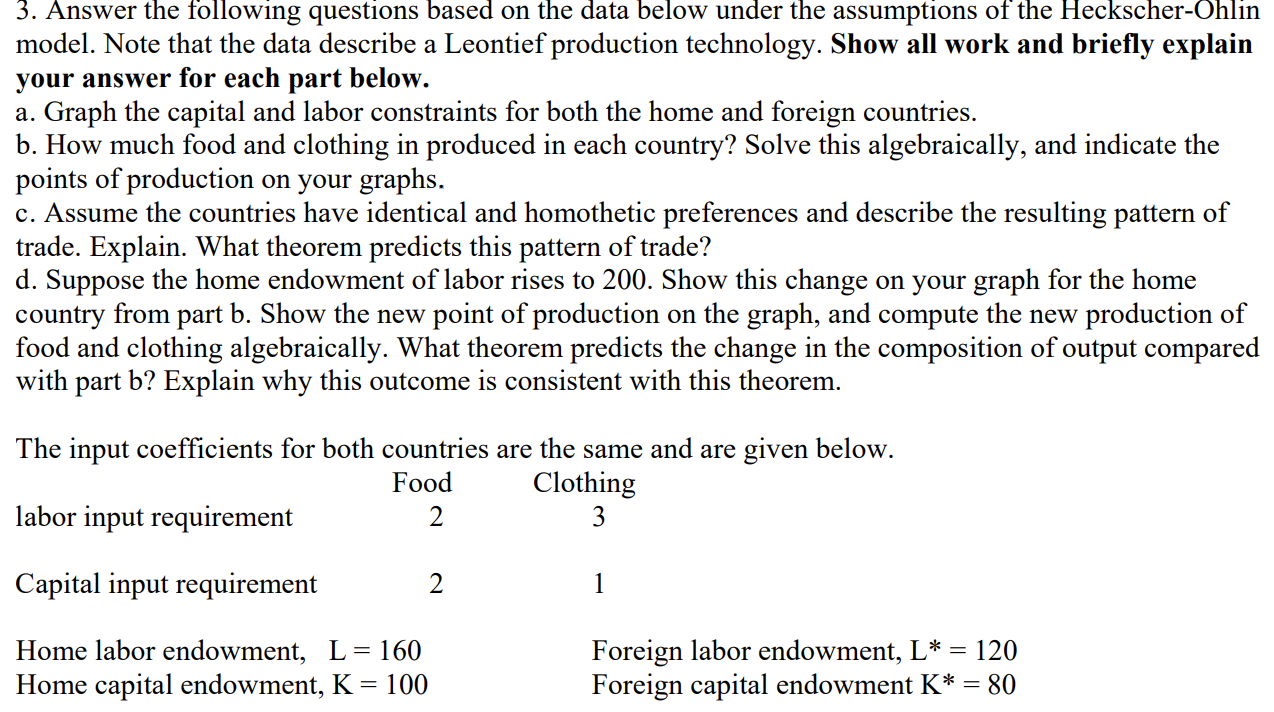
3. Answer the following questions based on the data below under the assumptions of the Heckscher-Ohlin model. Note that the data describe a Leontief production technology. Show all work and briefly explain your answer for each part below. a. Graph the capital and labor constraints for both the home and foreign countries. b. How much food and clothing in produced in each country? Solve this algebraically, and indicate the points of production on your graphs. c. Assume the countries have identical and homothetic preferences and describe the resulting pattern of trade. Explain. What theorem predicts this pattern of trade? d. Suppose the home endowment of labor rises to 200. Show this change on your graph for the home country from part b. Show the new point of production on the graph, and compute the new production of food and clothing algebraically. What theorem predicts the change in the composition of output compared with part b? Explain why this outcome is consistent with this theorem. The input coefficients for both countries are the same and are given below. Food Clothing labor input requirement 2 3 Capital input requirement 2 1 Home labor endowment, L = 160 Home capital endowment, K = 100 Foreign labor endowment, L* = 120 Foreign capital endowment K* = 80 3. Answer the following questions based on the data below under the assumptions of the Heckscher-Ohlin model. Note that the data describe a Leontief production technology. Show all work and briefly explain your answer for each part below. a. Graph the capital and labor constraints for both the home and foreign countries. b. How much food and clothing in produced in each country? Solve this algebraically, and indicate the points of production on your graphs. c. Assume the countries have identical and homothetic preferences and describe the resulting pattern of trade. Explain. What theorem predicts this pattern of trade? d. Suppose the home endowment of labor rises to 200. Show this change on your graph for the home country from part b. Show the new point of production on the graph, and compute the new production of food and clothing algebraically. What theorem predicts the change in the composition of output compared with part b? Explain why this outcome is consistent with this theorem. The input coefficients for both countries are the same and are given below. Food Clothing labor input requirement 2 3 Capital input requirement 2 1 Home labor endowment, L = 160 Home capital endowment, K = 100 Foreign labor endowment, L* = 120 Foreign capital endowment K* = 80
Step by Step Solution
There are 3 Steps involved in it

Get step-by-step solutions from verified subject matter experts
 Study Help