







Question: 3. As individuals. Using the material that has been covered in the lectures so far, analyze the agreed list of problems and prepare notes on:
3. As individuals. Using the material that has been covered in the lectures so far, analyze the agreed list of problems and prepare notes on:
a) Were Company Y successful, or unsuccessful, in the introduction of MRP II?
b) Did Company Y identify all of the factors relevant to the introduction of a new system at the outset and, if not, what did they miss?
c) What were the organizational impacts of the MRP II and how well were they managed?
4. As a group Reform in groups and briefly discuss each others report and attempt to produce an agreed statement on each of the above points.
Short answer is good!
Thanks!
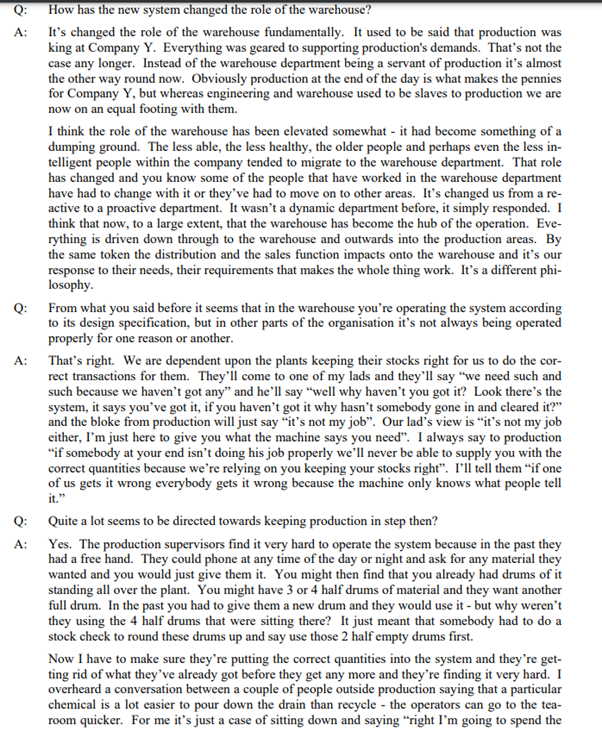
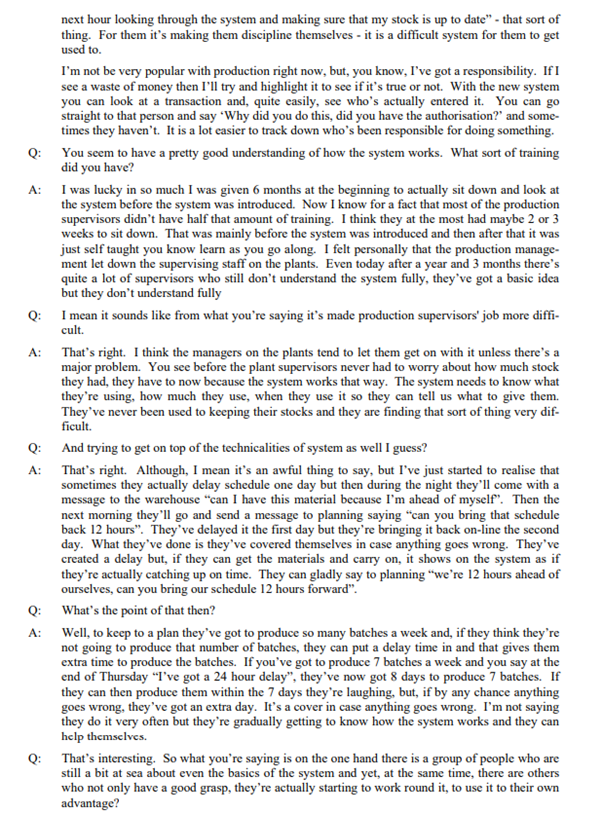
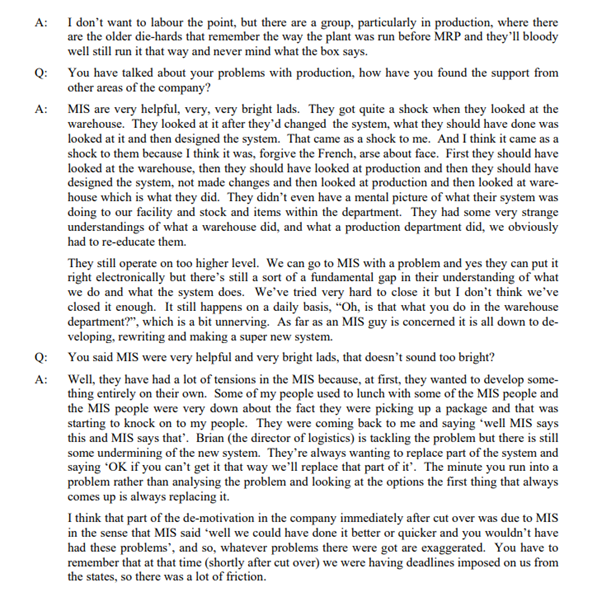
How has the new system changed the role of the warehouse? A: It's changed the role of the warehouse fundamentally. It used to be said that production was king at Company Y. Everything was geared to supporting production's demands. That's not the case any longer. Instead of the warehouse department being a servant of production it's almost the other way round now. Obviously production at the end of the day is what makes the pennies for Company Y, but whereas engineering and warehouse used to be slaves to production we are now on an equal footing with them. I think the role of the warehouse has been elevated somewhat - it had become something of a dumping ground. The less able, the less healthy, the older people and perhaps even the less in- telligent people within the company tended to migrate to the warehouse department. That role has changed and you know some of the people that have worked in the warehouse department have had to change with it or they've had to move on to other areas. It's changed us from a re- active to a proactive department. It wasn't a dynamic department before, it simply responded. I think that now, to a large extent, that the warehouse has become the hub of the operation. Eve- rything is driven down through to the warehouse and outwards into the production areas. By the same token the distribution and the sales function impacts onto the warehouse and it's our response to their needs, their requirements that makes the whole thing work. It's a different phi- losophy. Q: From what you said before it seems that in the warehouse you're operating the system according to its design specification, but in other parts of the organisation it's not always being operated properly for one reason or another. A: That's right. We are dependent upon the plants keeping their stocks right for us to do the cor- rect transactions for them. They'll come to one of my lads and they'll say we need such and such because we haven't got any and he'll say well why haven't you got it? Look there's the system, it says you've got it, if you haven't got it why hasn't somebody gone in and cleared it?" and the bloke from production will just say it's not my job". Our lad's view is it's not my job either, I'm just here to give you what the machine says you need. I always say to production if somebody at your end isn't doing his job properly we'll never be able to supply you with the correct quantities because we're relying on you keeping your stocks right. I'll tell them if one of us gets it wrong everybody gets it wrong because the machine only knows what people tell it." Q: Quite a lot seems to be directed towards keeping production in step then? A: Yes. The production supervisors find it very hard to operate the system because in the past they had a free hand. They could phone at any time of the day or night and ask for any material they wanted and you would just give them it. You might then find that you already had drums of it standing all over the plant. You might have 3 or 4 half drums of material and they want another full drum. In the past you had to give them a new drum and they would use it - but why weren't they using the 4 half drums that were sitting there? It just meant that somebody had to do a stock check to round these drums up and say use those 2 half empty drums first. Now I have to make sure they're putting the correct quantities into the system and they're get- ting rid of what they've already got before they get any more and they're finding it very hard. I overheard a conversation between a couple of people outside production saying that a particular chemical is a lot easier to pour down the drain than recycle - the operators can go to the tea- room quicker. For me it's just a case of sitting down and saying right I'm going to spend the A: next hour looking through the system and making sure that my stock is up to date - that sort of thing. For them it's making them discipline themselves - it is a difficult system for them to get used to. I'm not be very popular with production right now, but, you know, I've got a responsibility. IfI see a waste of money then I'll try and highlight it to see if it's true or not. With the new system you can look at a transaction and quite easily, see who's actually entered it. You can go straight to that person and say 'Why did you do this, did you have the authorisation?' and some- times they haven't. It is a lot easier to track down who's been responsible for doing something. Q: You seem to have a pretty good understanding of how the system works. What sort of training did you have? I was lucky in so much I was given 6 months at the beginning to actually sit down and look at the system before the system was introduced. Now I know for a fact that most of the production supervisors didn't have half that amount of training. I think they at the most had maybe 2 or 3 weeks to sit down. That was mainly before the system was introduced and then after that it was just self taught you know learn as you go along. I felt personally that the production manage- ment let down the supervising staff on the plants. Even today after a year and 3 months there's quite a lot of supervisors who still don't understand the system fully, they've got a basic idea but they don't understand fully Q: I mean it sounds like from what you're saying it's made production supervisors' job more diffi- cult. A: That's right. I think the managers on the plants tend to let them get on with it unless there's a major problem. You see before the plant supervisors never had to worry about how much stock they had, they have to now because the system works that way. The system needs to know what they're using, how much they use, when they use it so they can tell us what to give them. They've never been used to keeping their stocks and they are finding that sort of thing very dif- ficult Q: And trying to get on top of the technicalities of system as well I guess? That's right. Although, I mean it's an awful thing to say, but I've just started to realise that sometimes they actually delay schedule one day but then during the night they'll come with a message to the warehouse "can I have this material because I'm ahead of myself". Then the next morning they'll go and send a message to planning saying "can you bring that schedule back 12 hours". They've delayed it the first day but they're bringing it back on-line the second day. What they've done is they've covered themselves in case anything goes wrong. They've created a delay but, if they can get the materials and carry on, it shows on the system as if they're actually catching up on time. They can gladly say to planning we're 12 hours ahead of ourselves, can you bring our schedule 12 hours forward". Q: What's the point of that then? Well, to keep to a plan they've got to produce so many batches a week and, if they think they're not going to produce that number of batches, they can put a delay time in and that gives them extra time to produce the batches. If you've got to produce 7 batches a week and you say at the end of Thursday I've got a 24 hour delay", they've now got 8 days to produce 7 batches. If they can then produce them within the 7 days they're laughing, but, if by any chance anything goes wrong, they've got an extra day. It's a cover in case anything goes wrong. I'm not saying they do it very often but they're gradually getting to know how the system works and they can help themselves. Q: That's interesting. So what you're saying is on the one hand there is a group of people who are still a bit at sea about even the basics of the system and yet, at the same time, there are others who not only have a good grasp, they're actually starting to work round it, to use it to their own advantage? A: A: A: A: I don't want to labour the point, but there are a group, particularly in production, where there are the older die-hards that remember the way the plant was run before MRP and they'll bloody well still run it that way and never mind what the box says. Q: You have talked about your problems with production, how have you found the support from other areas of the company? MIS are very helpful, very, very bright lads. They got quite a shock when they looked at the warehouse. They looked at it after they'd changed the system, what they should have done was looked at it and then designed the system. That came as a shock to me. And I think it came as a shock to them because I think it was, forgive the French, arse about face. First they should have looked at the warehouse, then they should have looked at production and then they should have designed the system, not made changes and then looked at production and then looked at ware- house which is what they did. They didn't even have a mental picture of what their system was doing to our facility and stock and items within the department. They had some very strange understandings of what a warehouse did, and what a production department did, we obviously had to re-educate them. They still operate on too higher level. We can go to MIS with a problem and yes they can put it right electronically but there's still a sort of a fundamental gap in their understanding of what we do and what the system does. We've tried very hard to close it but I don't think we've closed it enough. It still happens on a daily basis, "Oh, is that what you do in the warehouse department?", which is a bit unnerving. As far as an MIS guy is concerned it is all down to de veloping, rewriting and making a super new system. Q: You said MIS were very helpful and very bright lads, that doesn't sound too bright? Well, they have had a lot of tensions in the MIS because, at first, they wanted to develop some- thing entirely on their own. Some of my people used to lunch with some of the MIS people and the MIS people were very down about the fact they were picking up a package and that was starting to knock on to my people. They were coming back to me and saying 'well MIS says this and MIS says that'. Brian (the director of logistics) is tackling the problem but there is still some undermining of the new system. They're always wanting to replace part of the system and saying 'OK if you can't get it that way we'll replace that part of it. The minute you run into a problem rather than analysing the problem and looking at the options the first thing that always comes up is always replacing it. I think that part of the de-motivation in the company immediately after cut over was due to MIS in the sense that MIS said 'well we could have done it better or quicker and you wouldn't have had these problems', and so, whatever problems there were got are exaggerated. You have to remember that at that time (shortly after cut over) we were having deadlines imposed on us from the states, so there was a lot of friction. AStep by Step Solution
There are 3 Steps involved in it
1 Expert Approved Answer
Step: 1 Unlock

Question Has Been Solved by an Expert!
Get step-by-step solutions from verified subject matter experts
Step: 2 Unlock
Step: 3 Unlock
 Study Help