







Question: 3. C# switch statement plc question Consider the following C switch statement: switch (ch) {case'n': new_cmd(); case 'o': open_cmd(); case 'c': close_cmd(); case 's': save_cmd();
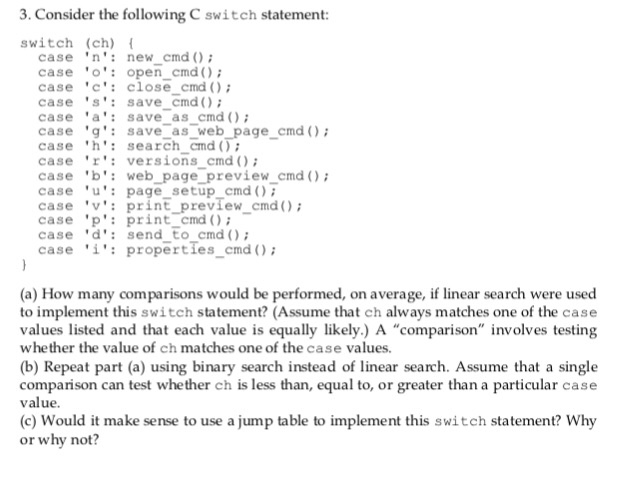
Consider the following C switch statement: switch (ch) {case'n': new_cmd(); case 'o': open_cmd(); case 'c': close_cmd(); case 's': save_cmd(); case 'a': save_as_cmd(); case 'g': save_as_web_page_cmd(); case 'h': search_and(); case 'r': versions_cmd(); case 'b': web_page_preview_cmd(); case 'u': page_setup_cmd(); case 'v': print_preview_cmd(); case 'p': print_cmd(); case 'd': send_to cmd(); case 'i': properties_cmd(); (a) How many comparisons would be performed, on average, if linear search were used to implement this switch statement? (Assume that ch always matches one of the case values listed and that each value is equally likely.) A "comparison" involves testing whether the value of ch matches one of the case values. (b) Repeat part (a) using binary search instead of linear search. Assume that a single comparison can test whether ch is less than, equal to, or greater than a particular case value. (c) Would it make sense to use a jump table to implement this switch statement? Why or why not
Step by Step Solution
There are 3 Steps involved in it

Get step-by-step solutions from verified subject matter experts
 Study Help