







Question: 3. , Chapter 10 Assume that security returns are generated by the single-index model R,aB,RM where R, is the excess return for security i and
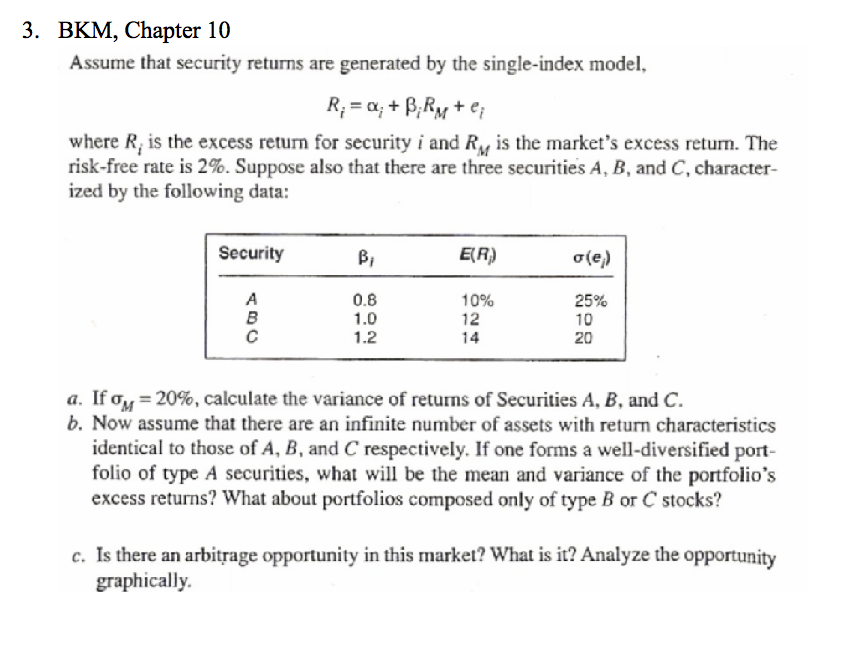
3. , Chapter 10 Assume that security returns are generated by the single-index model R,aB,RM where R, is the excess return for security i and Ry is the market's excess return. The risk-free rate is 2%. Suppose also that there are three securities A, B, and C, character ized by the following data: Security E(R) B o(e) A 0.8 1.0 10% 12 25% 10 20 1.2 14 a. If oy 20%, calculate the variance of returns of Securities A, B, and C. b. Now assume that there are an infinite number of assets with return characteristics identical to those of A, B, and C respectively. If one forms a well-diversified port folio of type A securities, what will be the mean and variance of the portfolio's excess returns? What about portfolios composed only of type B or C stocks? c. Is there an arbitrage opportunity in this market? What is it? Analyze the opportunity graphically BC 3. , Chapter 10 Assume that security returns are generated by the single-index model R,aB,RM where R, is the excess return for security i and Ry is the market's excess return. The risk-free rate is 2%. Suppose also that there are three securities A, B, and C, character ized by the following data: Security E(R) B o(e) A 0.8 1.0 10% 12 25% 10 20 1.2 14 a. If oy 20%, calculate the variance of returns of Securities A, B, and C. b. Now assume that there are an infinite number of assets with return characteristics identical to those of A, B, and C respectively. If one forms a well-diversified port folio of type A securities, what will be the mean and variance of the portfolio's excess returns? What about portfolios composed only of type B or C stocks? c. Is there an arbitrage opportunity in this market? What is it? Analyze the opportunity graphically BC
Step by Step Solution
There are 3 Steps involved in it

Get step-by-step solutions from verified subject matter experts
 Study Help