



Question: 3 Coffee Bean Incorporated (CB) processes and distributes high-quality coffee. CBI buys coffee beans from around the world and roasts, blends, and packages them
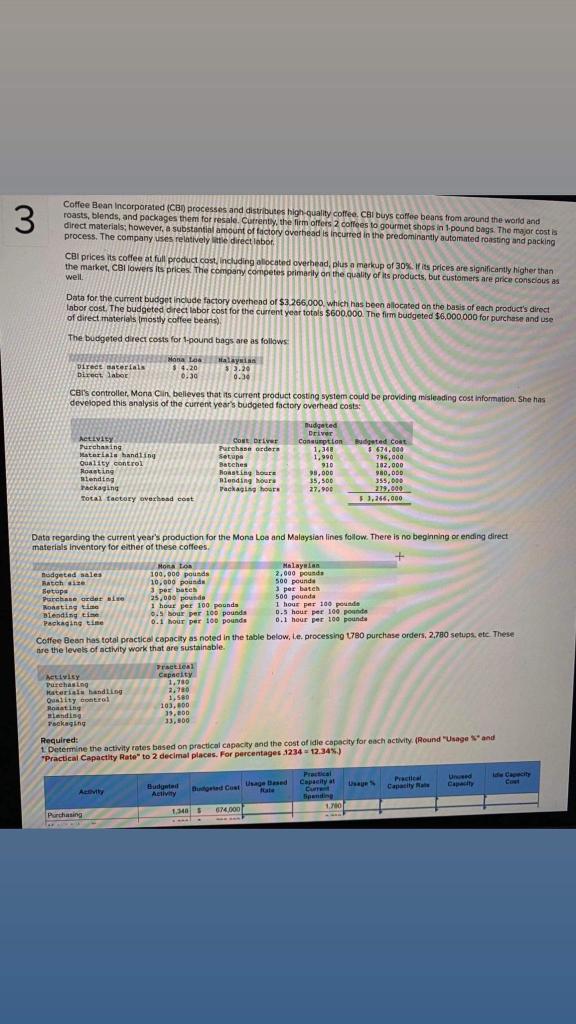
3 Coffee Bean Incorporated (CB) processes and distributes high-quality coffee. CBI buys coffee beans from around the world and roasts, blends, and packages them for resale. Currently, the firm offers 2 coffees to gourmet shops in 1-pound bags. The major cost is direct materials; however, a substantial amount of factory overhead is incurred in the predominantly automated roasting and packing process. The company uses relatively little direct labor CBI prices its coffee at full product cost, including allocated overhead, plus a markup of 30%. If its prices are significantly higher than the market, CBI lowers its prices. The company competes primarily on the quality of its products, but customers are price conscious as well Data for the current budget include factory overhead of $3.266,000, which has been allocated on the basis of each product's direct labor cost. The budgeted direct labor cost for the current year totals $600,000. The firm budgeted $6,000,000 for purchase and use of direct materials (mostly coffee beans). The budgeted direct costs for 1-pound bags are as follows Direct materials Direct labor Mona Los $4.20 0.30 Malaysian 33.20 0.30 CBI's controller, Mana Clin, believes that its current product costing system could be providing misleading cost information. She has developed this analysis of the current year's budgeted factory overhead costs: Activity Purchasing Materials handling Quality control Roasting Blending Packaging Total factory overhead cost Cost Driver Purchase orders Setupa Budgeted Driver Consumption 1,348 1,990 611 Batches Boasting hours Blending hours Packaging hours 910 99,000 35,500 27,900 Budgeted Cost $ 674,000 796,000 102,000 980,000 355,000 279,000 $ 3,266,000 Data regarding the current year's production for the Mona Loe and Malaysian lines follow. There is no beginning or ending direct materials inventory for either of these coffees. Budgeted sales Ratch size Purchase order sise Roasting time Blending time Packaging time Mona Loa 100,000 pounds 10,000 pounds 3 per batch 25,000 pounds 1 hour per 100 pounds 0.5 hour per 100 pounds 0.1 hour per 100 pounds Malaysian 2,000 pounds 500 pounds 3 per batch 500 pounds 1 hour per 100 pounds 0.5 hour per 100 pounds 0.1 hour per 100 pounds Coffee Bean has total practical capacity as noted in the table below, i.e. processing 1780 purchase orders, 2,780 setups, etc. These are the levels of activity work that are sustainable. Activity Practical Capacity Purchasing Katerials handling Quality control 1,780 2,780 1,580 Roasting 103,800 39,800 33,800 Blending Packaging Required: 1 Determine the activity rates based on practical capacity and the cost of idle capacity for each activity. (Round "Usage % and "Practical Capactity Rate" to 2 decimal places. For percentages 1234 = 12.34%) Activity Purchasing Practical Activity Budgeted Budgeted Cost Usage Based Capacity at Usage Rate CUT Spending Practical Capacity Rate Unused Capacity ide Capecity Cost 1,340 674,000 1.700
Step by Step Solution
There are 3 Steps involved in it

Get step-by-step solutions from verified subject matter experts