







Question: #3. [Colliding Sticking Disks] Two identical uniform solid disks, each of mass M and radius R, can slide on a horizontal frictionless surface. Before After
![#3. [Colliding Sticking Disks] Two identical uniform solid disks, each of](https://s3.amazonaws.com/si.experts.images/answers/2024/06/66792a2edce4a_68666792a2ec0918.jpg)
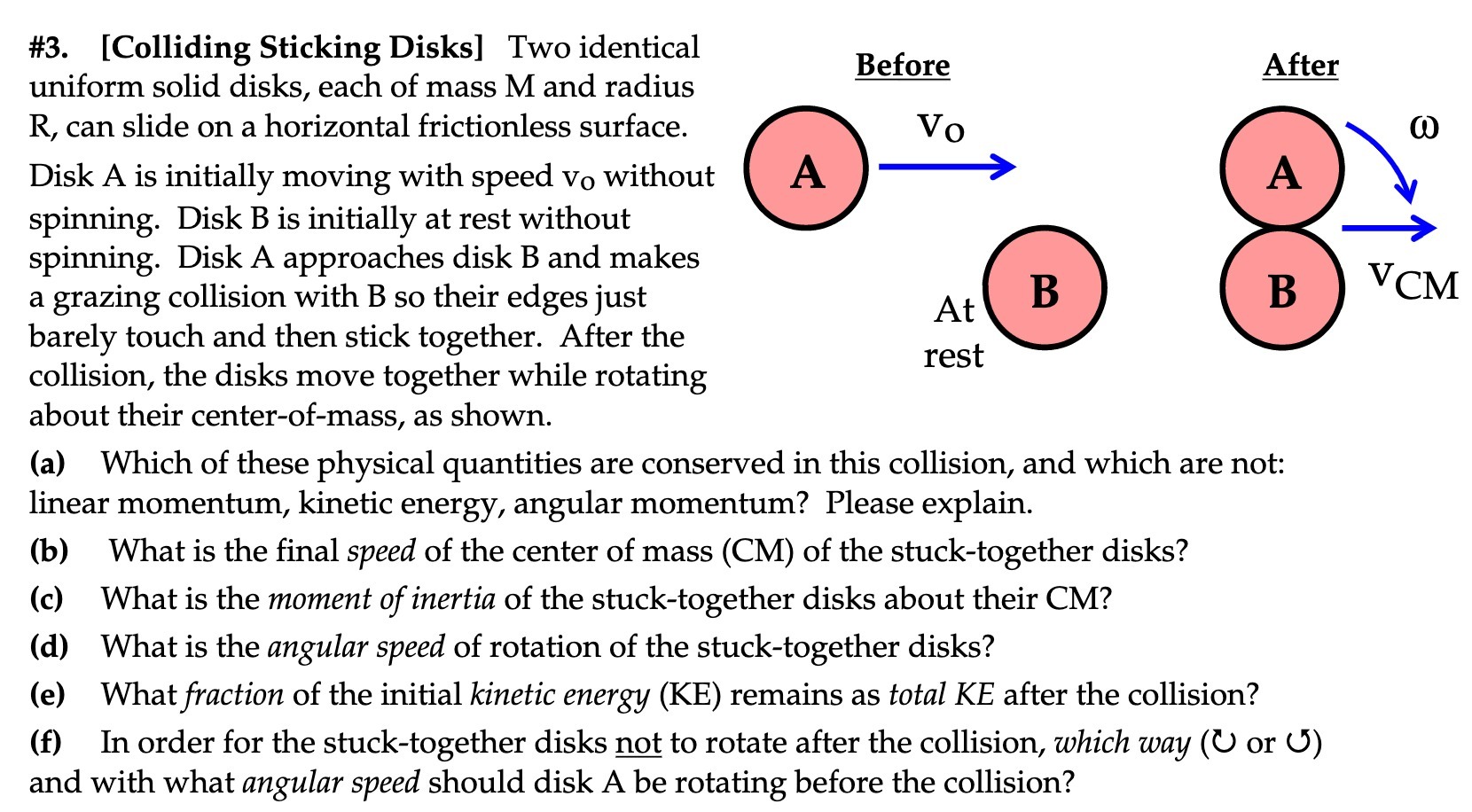
#3. [Colliding Sticking Disks] Two identical uniform solid disks, each of mass M and radius R, can slide on a horizontal frictionless surface. Before After Disk A is initially moving with speed v0 without spinning. Disk B is initially at rest Without spinning. Disk A approaches disk B and makes a grazing collision with B so their edges just At barely touch and then stick together. After the collision, the disks move together While rotating about their center-of-mass, as shown. 3:, VCM rest (a) Which of these physical quantities are conserved in this collision, and which are not: linear momentum, kinetic energy, angular momentum? Please explain. (b) What is the nal speed of the center of mass (CM) of the stuck-together disks? (c) What is the moment of inertia of the stuck-together disks about their CM? (d) What is the angular speed of rotation of the stuck-together disks? (e) What fraction of the initial kinetic energy (KE) remains as total KE after the collision? (f) In order for the stuck-together disks not to rotate after the collision, which way (C) or O) and with what angular speed should disk A be rotating before the collision
Step by Step Solution
There are 3 Steps involved in it

Get step-by-step solutions from verified subject matter experts
 Study Help