







Question: 3. Consider an optical-bypass-enabled network shown below with the links and nodes connected as shown, and the link distances as marked (in units of
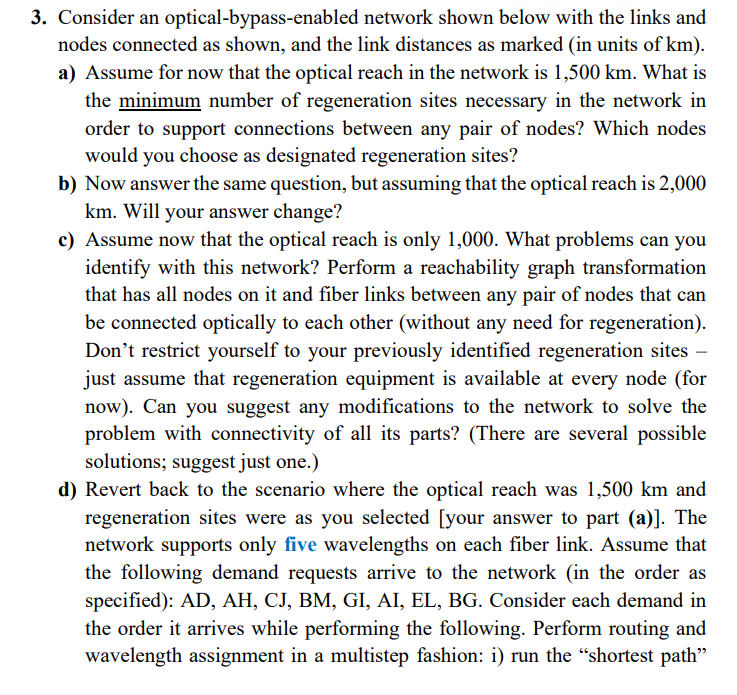
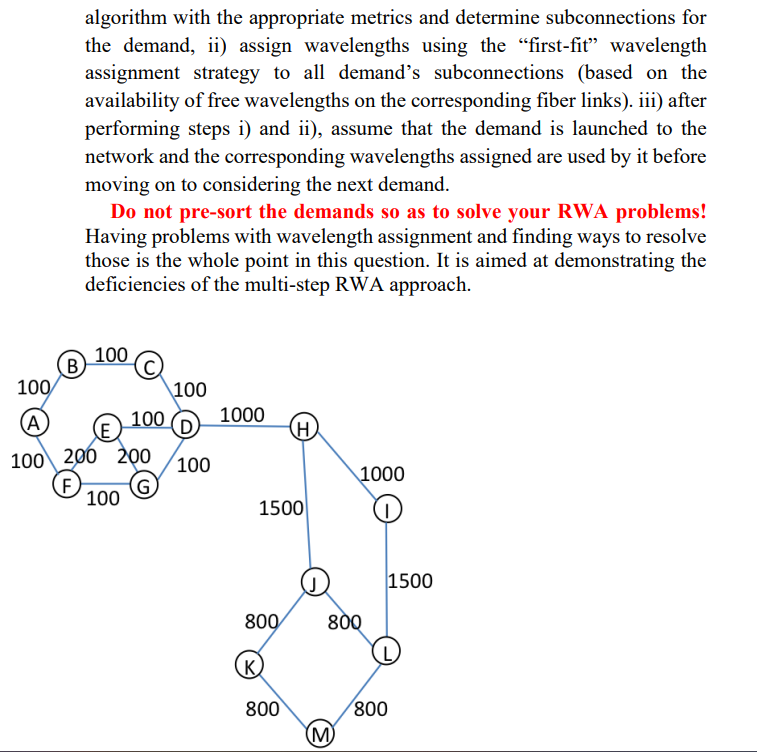
3. Consider an optical-bypass-enabled network shown below with the links and nodes connected as shown, and the link distances as marked (in units of km). a) Assume for now that the optical reach in the network is 1,500 km. What is the minimum number of regeneration sites necessary in the network in order to support connections between any pair of nodes? Which nodes would you choose as designated regeneration sites? b) Now answer the same question, but assuming that the optical reach is 2,000 km. Will your answer change? c) Assume now that the optical reach is only 1,000. What problems can you identify with this network? Perform a reachability graph transformation that has all nodes on it and fiber links between any pair of nodes that can be connected optically to each other (without any need for regeneration). Don't restrict yourself to your previously identified regeneration sites - just assume that regeneration equipment is available at every node (for now). Can you suggest any modifications to the network to solve the problem with connectivity of all its parts? (There are several possible solutions; suggest just one.) d) Revert back to the scenario where the optical reach was 1,500 km and regeneration sites were as you selected [your answer to part (a)]. The network supports only five wavelengths on each fiber link. Assume that the following demand requests arrive to the network (in the order as specified): AD, AH, CJ, BM, GI, AI, EL, BG. Consider each demand in the order it arrives while performing the following. Perform routing and wavelength assignment in a multistep fashion: i) run the shortest path" algorithm with the appropriate metrics and determine subconnections for the demand, ii) assign wavelengths using the "first-fit" wavelength assignment strategy to all demand's subconnections (based on the availability of free wavelengths on the corresponding fiber links). iii) after performing steps i) and ii), assume that the demand is launched to the network and the corresponding wavelengths assigned are used by it before moving on to considering the next demand. Do not pre-sort the demands so as to solve your RWA problems! Having problems with wavelength assignment and finding ways to resolve those is the whole point in this question. It is aimed at demonstrating the deficiencies of the multi-step RWA approach. 100 B 100 100 (A) 100 1000 H 100 200 200 100 1000 F (G) 100 1500 1500 800 800 (K) 800 800 (M)
Step by Step Solution
3.42 Rating (155 Votes )
There are 3 Steps involved in it
To answer the given questions we need to analyze the network topology and the optical reach limitations However since the network topology is not provided in the text it is difficult to provide a spec... View full answer

Get step-by-step solutions from verified subject matter experts
 Study Help