





Question: 3. Consider ay + by' + cy = f(x) where a, b, c ER, a 0, and y = y(x). (a) Given y(x0) =

3. Consider cry\3. Consider cry\
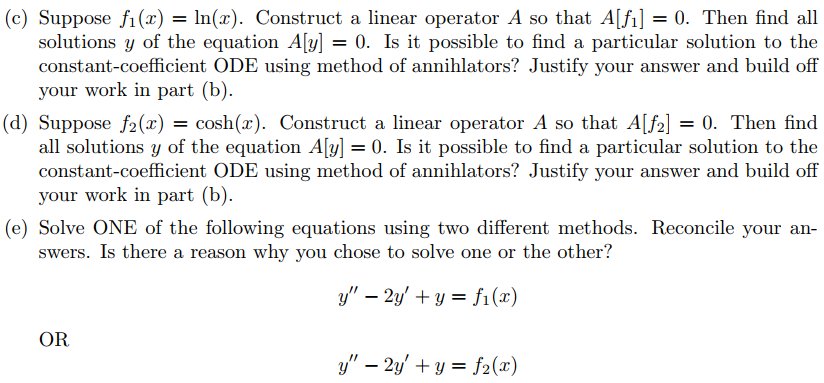
3. Consider cry\" + by' + cy = f(I) Where a, b, c E R, :1 34E 0, and y = 11(1). (a) Given y{.:r;g] = Y0 and y'(3;0] = Y1, when does a unique solution exist? {13) Supposing a solution 3; exists, describe the relationship between y",y',y and 3'. Use a theorem [or show that the denition applies] to justify this relationship. (c) Suppose fi(r) = In(x). Construct a linear operator A so that A[fi] = 0. Then find all solutions y of the equation Aly] = 0. Is it possible to find a particular solution to the constant-coefficient ODE using method of annihlators? Justify your answer and build off your work in part (b). (d) Suppose f2(x) = cosh(x). Construct a linear operator A so that Alf2] = 0. Then find all solutions y of the equation Aly] = 0. Is it possible to find a particular solution to the constant-coefficient ODE using method of annihlators? Justify your answer and build off your work in part (b). (e) Solve ONE of the following equations using two different methods. Reconcile your an- swers. Is there a reason why you chose to solve one or the other? y" - 2y' ty = fi(x) OR. y"- 2y ty = f2(x)

3. Consider ay" + by' + cy = f(x) where a, b, c ER, a 0, and y = y(x). (a) Given y(x0) = Yo and y'(x0) = Y, when does a unique solution exist? (b) Supposing a solution y exists, describe the relationship between y", y', y and f. Use a theorem (or show that the definition applies) to justify this relationship.
Step by Step Solution

There are 3 Steps involved in it

1 Expert Approved Answer
Step: 1 Unlock blur-text-image

Question Has Been Solved by an Expert!

Get step-by-step solutions from verified subject matter experts

Step: 2 Unlock
Step: 3 Unlock

Students Have Also Explored These Related Mathematics Questions!