







Question: ~ 3. Consider independent r.v.'s Xij, denoting the j-th sample from pop- ulation i, j = 1, . . ., m; i = 1,
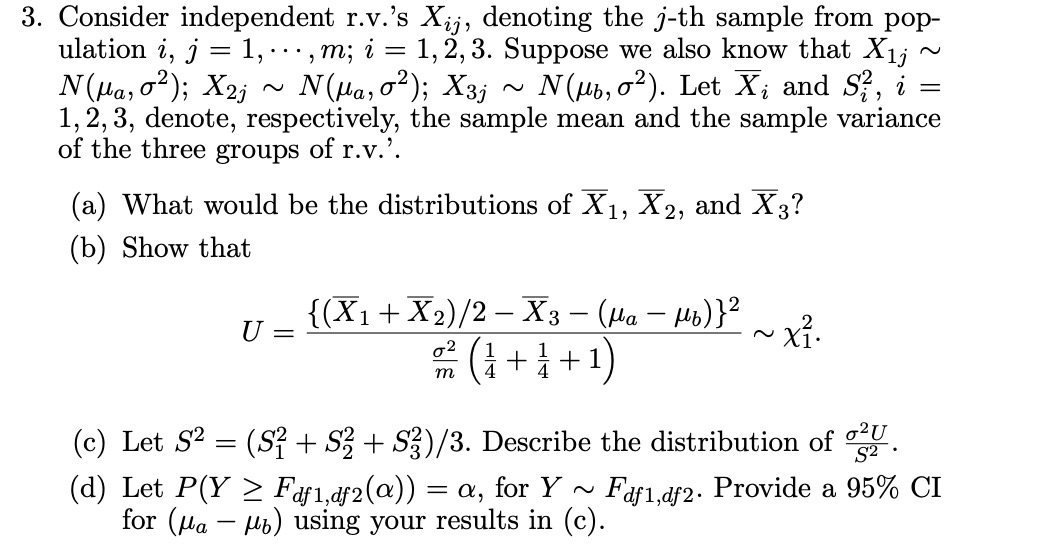
~ 3. Consider independent r.v.'s Xij, denoting the j-th sample from pop- ulation i, j = 1, . . ., m; i = 1, 2, 3. Suppose we also know that X1j N(b, o). Let Xi and S, i N(a, ); X2j ~ N(a, ); X3j ~ = 1, 2, 3, denote, respectively, the sample mean and the sample variance of the three groups of r.v.'. (a) What would be the distributions of X1, X2, and X3? (b) Show that U = {(X1 + X2)/2 X (a )} 3- - ~ m 02 (1 + +1) 2U (c) Let S = (S + S + 3)/3. Describe the distribution of 02. ~ (d) Let P(YFdf 1,df2(a)) = , for Y for (a b) using your results in (c). - Fdf1,df2. Provide a 95% CI
Step by Step Solution
There are 3 Steps involved in it

Get step-by-step solutions from verified subject matter experts
 Study Help