



Question: 3. Consider the data on the change in welfare for each voter for each policy that is contained in the table below. Note, amb~c~d~e) means
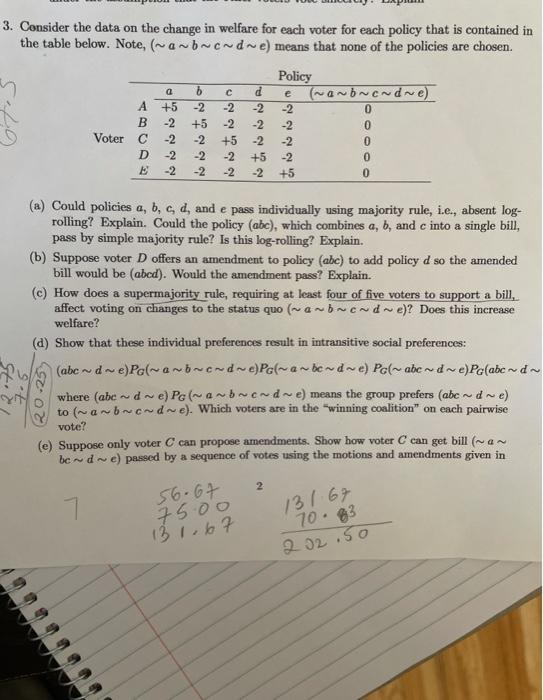
3. Consider the data on the change in welfare for each voter for each policy that is contained in the table below. Note, amb~c~d~e) means that none of the policies are chosen. Policy a (~a~b~o~d~e) b -2 +5 B Voter C D E +5 -2 -2 -2 -2 N N N J -2 -2 +5 -2 -2 d -2 -2 -2 +5 -2 e -2 -2 -2 -2 +5 0 0 0 0 0 (a) Could policies a, b, c, d, and e pass individually using majority rule, i.e., absent log- rolling? Explain. Could the policy (abc), which combines a, b, and c into a single bill, pass by simple majority rule? Is this log-rolling? Explain. (b) Suppose voter D offers an amendment to policy (abc) to add policy d so the amended bill would be (abed). Would the amendment pass? Explain. (c) How does a supermajority rule, requiring at least four of five voters to support a bill, affect voting on changes to the status quo (@mbwende)? Does this increase welfare? (a) Show that these individual preferences result in intransitive social preferences: (abe de)PalabcdePan bede) Palabede) Pg(abed where (abe - de) Po(abrede) means the group prefers (abc ~ d~e) to mambwe). Which voters are in the winning coalition" on each pairwise vote? (e) Suppose only voter C can propose amendments. Show how voter C can get bill wa berde) passed by a sequence of votes using the motions and amendments given in Sticl 2 13167 56.67 75.00 13 1.67 70.83 202.50 @@@@@@ 3. Consider the data on the change in welfare for each voter for each policy that is contained in the table below. Note, amb~c~d~e) means that none of the policies are chosen. Policy a (~a~b~o~d~e) b -2 +5 B Voter C D E +5 -2 -2 -2 -2 N N N J -2 -2 +5 -2 -2 d -2 -2 -2 +5 -2 e -2 -2 -2 -2 +5 0 0 0 0 0 (a) Could policies a, b, c, d, and e pass individually using majority rule, i.e., absent log- rolling? Explain. Could the policy (abc), which combines a, b, and c into a single bill, pass by simple majority rule? Is this log-rolling? Explain. (b) Suppose voter D offers an amendment to policy (abc) to add policy d so the amended bill would be (abed). Would the amendment pass? Explain. (c) How does a supermajority rule, requiring at least four of five voters to support a bill, affect voting on changes to the status quo (@mbwende)? Does this increase welfare? (a) Show that these individual preferences result in intransitive social preferences: (abe de)PalabcdePan bede) Palabede) Pg(abed where (abe - de) Po(abrede) means the group prefers (abc ~ d~e) to mambwe). Which voters are in the winning coalition" on each pairwise vote? (e) Suppose only voter C can propose amendments. Show how voter C can get bill wa berde) passed by a sequence of votes using the motions and amendments given in Sticl 2 13167 56.67 75.00 13 1.67 70.83 202.50 @@@@@@
Step by Step Solution
There are 3 Steps involved in it

Get step-by-step solutions from verified subject matter experts