







Question: 3. Consider the following Principal-Agent model with two possible actions (effort levels) E={eL=5,eH=8}. There are two possible revenue outcomes: H= 81000 and L=39000. There are
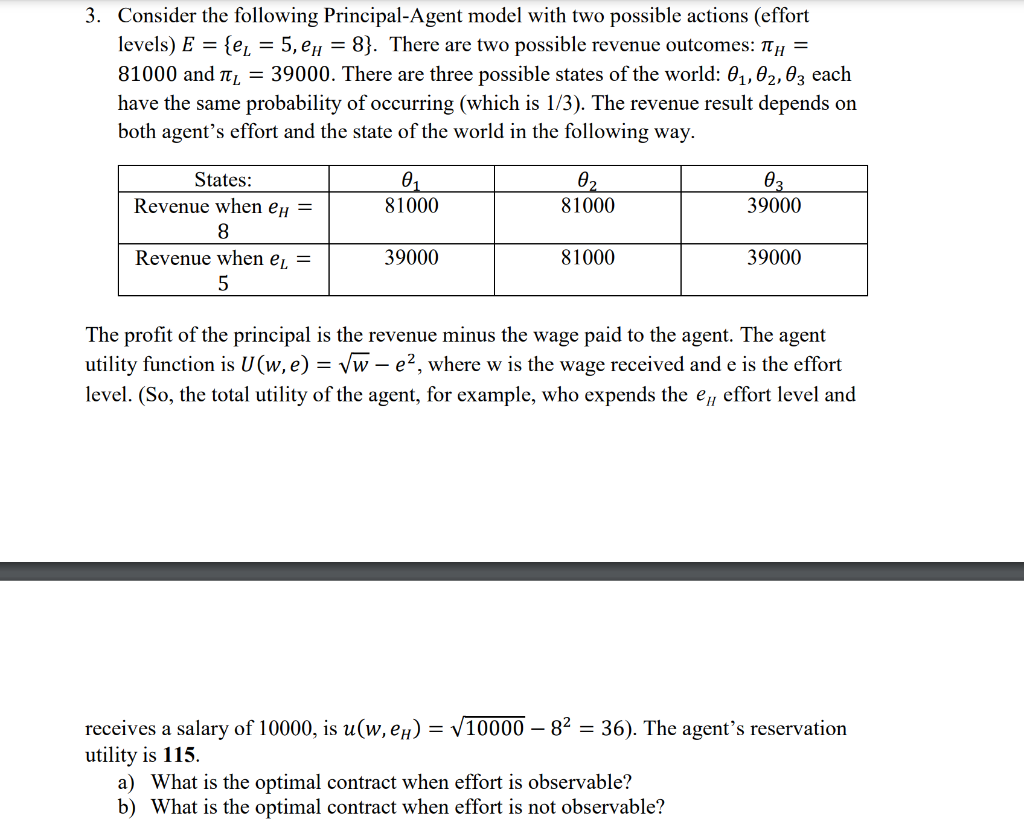
3. Consider the following Principal-Agent model with two possible actions (effort levels) E={eL=5,eH=8}. There are two possible revenue outcomes: H= 81000 and L=39000. There are three possible states of the world: 1,2,3 each have the same probability of occurring (which is 1/3 ). The revenue result depends on both agent's effort and the state of the world in the following way. The profit of the principal is the revenue minus the wage paid to the agent. The agent utility function is U(w,e)=we2, where w is the wage received and e is the effort level. (So, the total utility of the agent, for example, who expends the eH effort level and receives a salary of 10000 , is u(w,eH)=1000082=36). The agent's reservation utility is 115. a) What is the optimal contract when effort is observable? b) What is the optimal contract when effort is not observable? 3. Consider the following Principal-Agent model with two possible actions (effort levels) E={eL=5,eH=8}. There are two possible revenue outcomes: H= 81000 and L=39000. There are three possible states of the world: 1,2,3 each have the same probability of occurring (which is 1/3 ). The revenue result depends on both agent's effort and the state of the world in the following way. The profit of the principal is the revenue minus the wage paid to the agent. The agent utility function is U(w,e)=we2, where w is the wage received and e is the effort level. (So, the total utility of the agent, for example, who expends the eH effort level and receives a salary of 10000 , is u(w,eH)=1000082=36). The agent's reservation utility is 115. a) What is the optimal contract when effort is observable? b) What is the optimal contract when effort is not observable
Step by Step Solution
There are 3 Steps involved in it

Get step-by-step solutions from verified subject matter experts
 Study Help