







Question: 3. Consider the following problem. You are given a bit string of n bits. You can examine any bit in the string, to see if
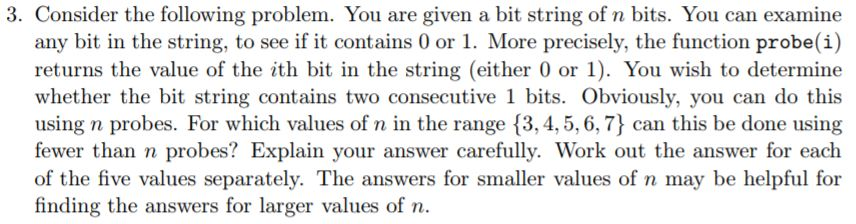
3. Consider the following problem. You are given a bit string of n bits. You can examine any bit in the string, to see if it contains 0 or 1. More precisely, the function probe(i) returns the value of the ith bit in the string (either 0 or 1). You wish to determine whether the bit string contains two consecutive 1 bits. Obviously, you can do this using n probes. For which values of n in the range 13,4,5, 6,7) can this be done using fewer than n probes? Explain your answer carefully. Work out the answer for each of the five values separately. The answers for smaller values of n may be helpful for finding the answers for larger values of n
Step by Step Solution
There are 3 Steps involved in it
1 Expert Approved Answer
Step: 1 Unlock

Question Has Been Solved by an Expert!
Get step-by-step solutions from verified subject matter experts
Step: 2 Unlock
Step: 3 Unlock
 Study Help