







Question: 3. Consider the function f : R {-3} - R : IH x +3 (a) Determine the general expression for f()(x), i.e., the formula of
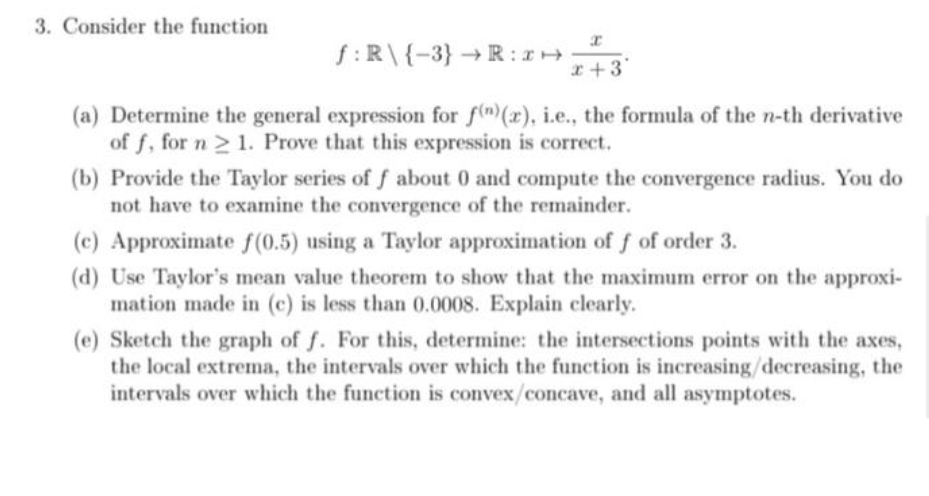
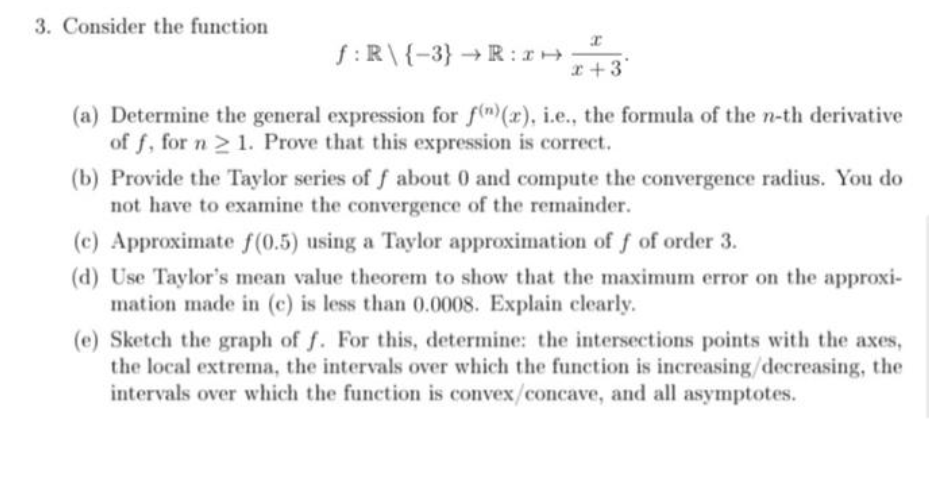
3. Consider the function f : R\\ {-3} - R : IH x +3 (a) Determine the general expression for f(")(x), i.e., the formula of the n-th derivative of f, for n > 1. Prove that this expression is correct. (b) Provide the Taylor series of f about 0 and compute the convergence radius. You do not have to examine the convergence of the remainder. (c) Approximate f(0.5) using a Taylor approximation of f of order 3. (d) Use Taylor's mean value theorem to show that the maximum error on the approxi- mation made in (c) is less than 0.0008. Explain clearly. (e) Sketch the graph of f. For this, determine: the intersections points with the axes, the local extrema, the intervals over which the function is increasing/ decreasing, the intervals over which the function is convex/concave, and all asymptotes
Step by Step Solution
There are 3 Steps involved in it

Get step-by-step solutions from verified subject matter experts
 Study Help