







Question: 3. Consider the $mathbb{Z}$-module homomorphisms $$ begin{aligned} alpha: mathbb{Z}_{5} ightarrow mathbb{Z}_{20}, & alpha(n)=4 n quad text { and } beta: mathbb{Z}_{20} ightarrow mathbb{Z}_{4}, quad beta(n)=n
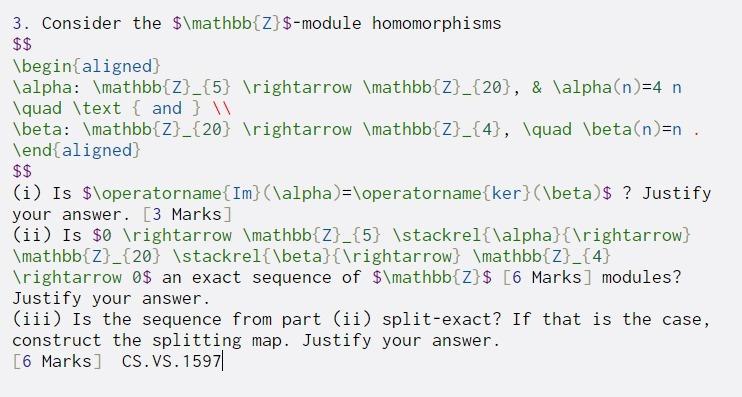
3. Consider the $\mathbb{Z}$-module homomorphisms $$ \begin{aligned} \alpha: \mathbb{Z}_{5} ightarrow \mathbb{Z}_{20}, & \alpha(n)=4 n \quad \text { and } \beta: \mathbb{Z}_{20} ightarrow \mathbb{Z}_{4}, \quad \beta(n)=n \end{aligned} $$ (i) Is $\operatorname{Im}(\alpha)=\operatorname{ker}(\beta) $ ? Justify your answer. [3 Marks ] (ii) Is $0 ightarrow \mathbb{Z}_{5} \stackrel{\alpha}{ ightarrow] \mathbb{Z}_{20} \stackrel{\beta}{ ightarrow} \mathbb{Z}_{4} ightarrow 0$ an exact sequence of $\mathbb{Z}$ [6 Marks] modules? Justify your answer. (iii) is the sequence from part (ii) split-exact? If that is the case, construct the splitting map. Justify your answer. [6 Marks] CS. VS. 1597||
Step by Step Solution
There are 3 Steps involved in it

Get step-by-step solutions from verified subject matter experts
 Study Help