





Question: 3. Consider the network (G, w) with V(G) = {a, b, c, d, e, f }, E(G) = {ab, ac, ad, ae, a f, bc,
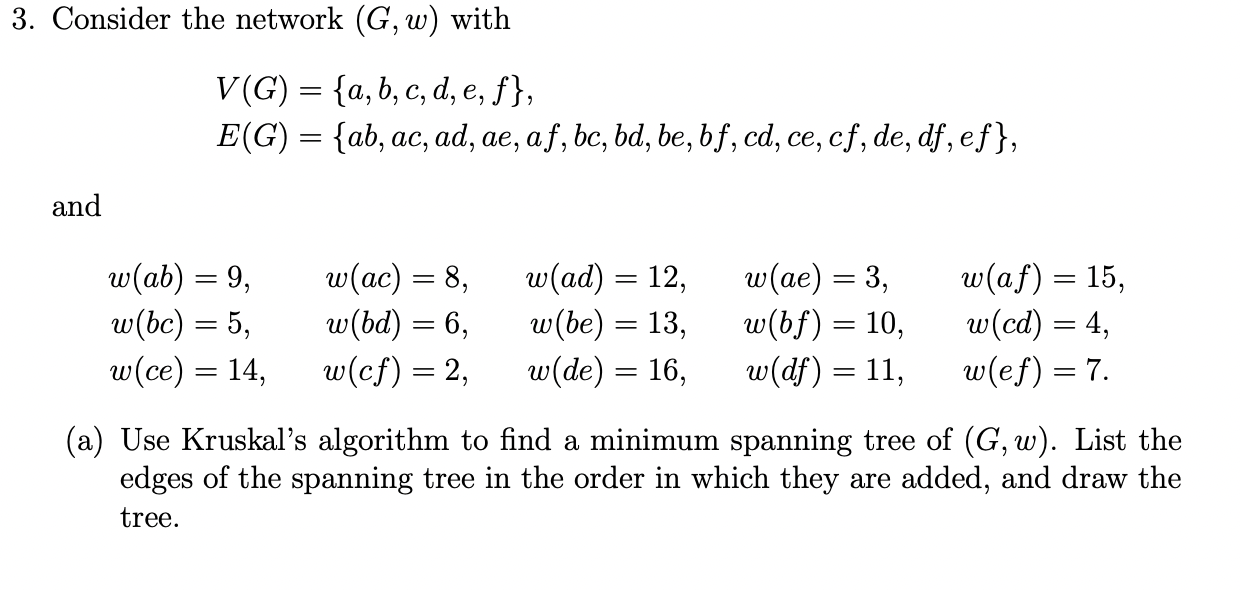

3. Consider the network (G, w) with V(G) = {a, b,3. Consider the network (G, w) with V(G) = {a, b,
3. Consider the network (G, w) with V(G) = {a, b, c, d, e, f }, E(G) = {ab, ac, ad, ae, a f, bc, bd, be, bf, cd, ce, cf, de, df, ef}, and w(ab) = 9, wac) = 8, w(ad) = 12, w(ae) = 3, w(af) = 15, w (bc) = 5, w(bd) = 6, w (be) = 13, w (bf ) = 10, w(cd) = 4, w (ce) = 14, w(cf) = 2, w(de) = 16, w(df) = 11, w(ef) = 7. (a) Use Kruskal's algorithm to find a minimum spanning tree of (G, w). List the edges of the spanning tree in the order in which they are added, and draw the tree.(b) Use the reverse-delete algorithm to nd a minimum spanning tree of (0,111). List the edges not in the spanning tree in the order in which they are removed. (0) Use Exercise 1 to show that the minimum spanning tree found by both algcr rithms is in fact the unique minimum spanning tree of (G, to)

Step by Step Solution

There are 3 Steps involved in it

1 Expert Approved Answer
Step: 1 Unlock blur-text-image

Question Has Been Solved by an Expert!

Get step-by-step solutions from verified subject matter experts

Step: 2 Unlock
Step: 3 Unlock

Students Have Also Explored These Related Mathematics Questions!