





Question: 3. Consider the plane: 3:1: + 43; + 32 = D (a) Verify that A = {(4, 3, U), (2, 3, 2)} and B =
3. Consider the plane: 3:1: + 43; + 32 = D (a)
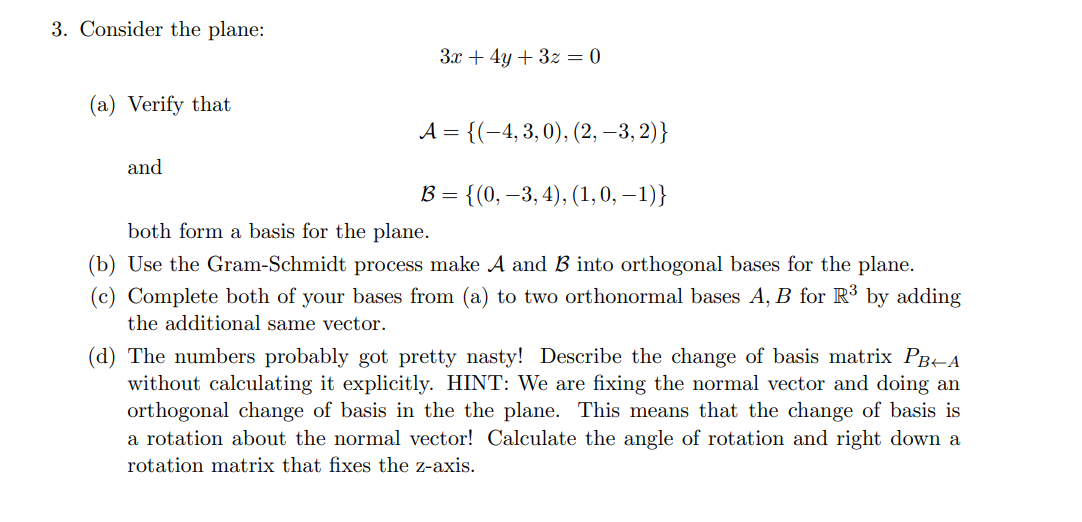
3. Consider the plane: 3:1: + 43; + 32 = D (a) Verify that A = {(4, 3, U), (2, 3, 2)} and B = {(0, 3,4), (1,0,1)} both form a basis for the plane. (b) Use the Gram-Schmidt process make A and B into orthogonal bases for the plane. (c) Complete both of your bases from (a) to two orthonormal bases A, B for R3 by adding the additional same vector. ((1) The numbers probably got pretty nasty! Describe the change of basis matrix PB4A without calculating it explicitly. HINT: We are xing the normal vector and doing an orthogonal change of basis in the the plane. This means that the change of basis is a rotation about the normal vector! Calculate the angle of rotation and right down a rotation matrix that xes the zaxis

Step by Step Solution

There are 3 Steps involved in it

1 Expert Approved Answer
Step: 1 Unlock blur-text-image
Question Has Been Solved by an Expert!

Get step-by-step solutions from verified subject matter experts

Step: 2 Unlock
Step: 3 Unlock

Students Have Also Explored These Related Mathematics Questions!