







Question: 3. Consider the real-valued function f(x) = 2x + 32 T (a) Establish the domain for f. (b) Identify any critical points. (c) Identify
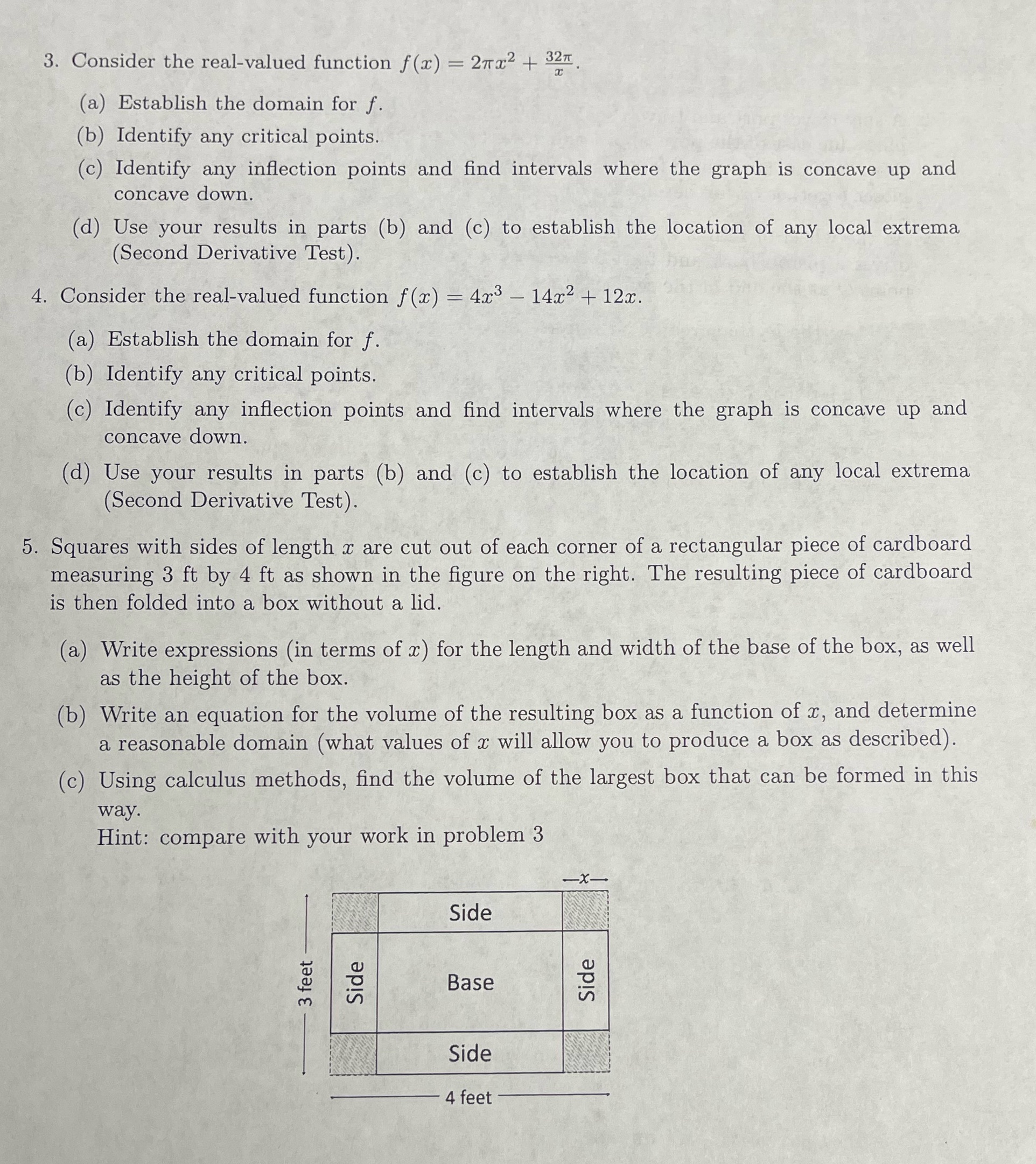
3. Consider the real-valued function f(x) = 2x + 32 T (a) Establish the domain for f. (b) Identify any critical points. (c) Identify any inflection points and find intervals where the graph is concave up and concave down. (d) Use your results in parts (b) and (c) to establish the location of any local extrema (Second Derivative Test). 4. Consider the real-valued function f(x) = 4x- 14x + 12x. (a) Establish the domain for f. (b) Identify any critical points. (c) Identify any inflection points and find intervals where the graph is concave up and concave down. (d) Use your results in parts (b) and (c) to establish the location of any local extrema (Second Derivative Test). 5. Squares with sides of length x are cut out of each corner of a rectangular piece of cardboard measuring 3 ft by 4 ft as shown in the figure on the right. The resulting piece of cardboard is then folded into a box without a lid. (a) Write expressions (in terms of x) for the length and width of the base of the box, as well as the height of the box. (b) Write an equation for the volume of the resulting box as a function of x, and determine a reasonable domain (what values of x will allow you to produce a box as described). (c) Using calculus methods, find the volume of the largest box that can be formed in this way. Hint: compare with your work in problem 3 3 feet Side -x- Side Base Side 4 feet Side
Step by Step Solution
There are 3 Steps involved in it

Get step-by-step solutions from verified subject matter experts
 Study Help