







Question: 3. Consider the set B - {xle x2, xe *2, e x/2}, and let W = Span(B). . Show that B is linearly independent, and
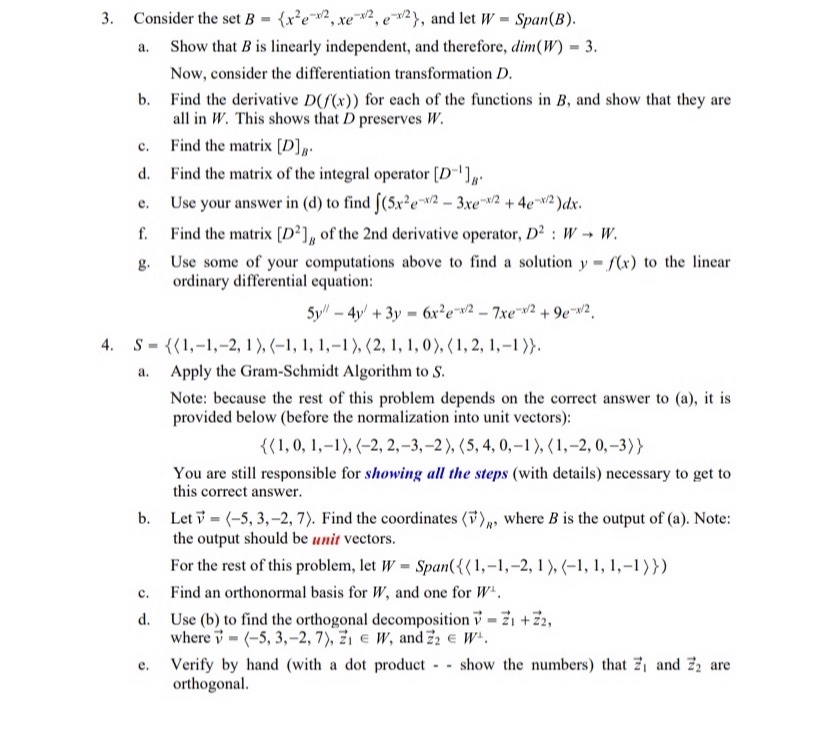
3. Consider the set B - {xle x2, xe *2, e x/2}, and let W = Span(B). . Show that B is linearly independent, and therefore, dim(W) = 3. Now, consider the differentiation transformation D. b. Find the derivative D(f(x)) for each of the functions in B, and show that they are all in W. This shows that D preserves W. c. Find the matrix [D] s. d. Find the matrix of the integral operator [D-1],. e. Use your answer in (d) to find ] (5x3e-x/2 - 3xe-x/2 + 4e-w/2 )dx. f. Find the matrix [D2],, of the 2nd derivative operator, D2 : W - W. g. Use some of your computations above to find a solution y = f(x) to the linear ordinary differential equation: 5yll - 4y + 3y - 6xle-x/2 - 7xe-x/2 + 9e-w/2. 4. S - {(1,-1,-2, 1 ), (-1, 1, 1,-1), (2, 1, 1, 0), ( 1, 2, 1,-1) }. a. Apply the Gram-Schmidt Algorithm to S. Note: because the rest of this problem depends on the correct answer to (a), it is provided below (before the normalization into unit vectors): {(1, 0, 1,-1), (-2, 2,-3,-2), (5, 4, 0,-1), (1,-2, 0,-3) } You are still responsible for showing all the steps (with details) necessary to get to this correct answer. b. Let v = (-5, 3,-2, 7). Find the coordinates (V),, where B is the output of (a). Note: the output should be unit vectors. For the rest of this problem, let W = Span({ ( 1, -1, -2, 1 ), (-1, 1, 1,-1) }) c. Find an orthonormal basis for W, and one for W. d. Use (b) to find the orthogonal decomposition V = 21 + 72, where v = (-5, 3,-2, 7), 71 6 W, and 72 e W. e. Verify by hand (with a dot product - - show the numbers) that Z, and 72 are orthogonal
Step by Step Solution
There are 3 Steps involved in it

Get step-by-step solutions from verified subject matter experts
 Study Help