







Question: (3) Consider two continuous random variables X, Y which have the uniform distribution on quadrilateral with vertices (0, 0), (0, 1), (1, 2), (1, 1).
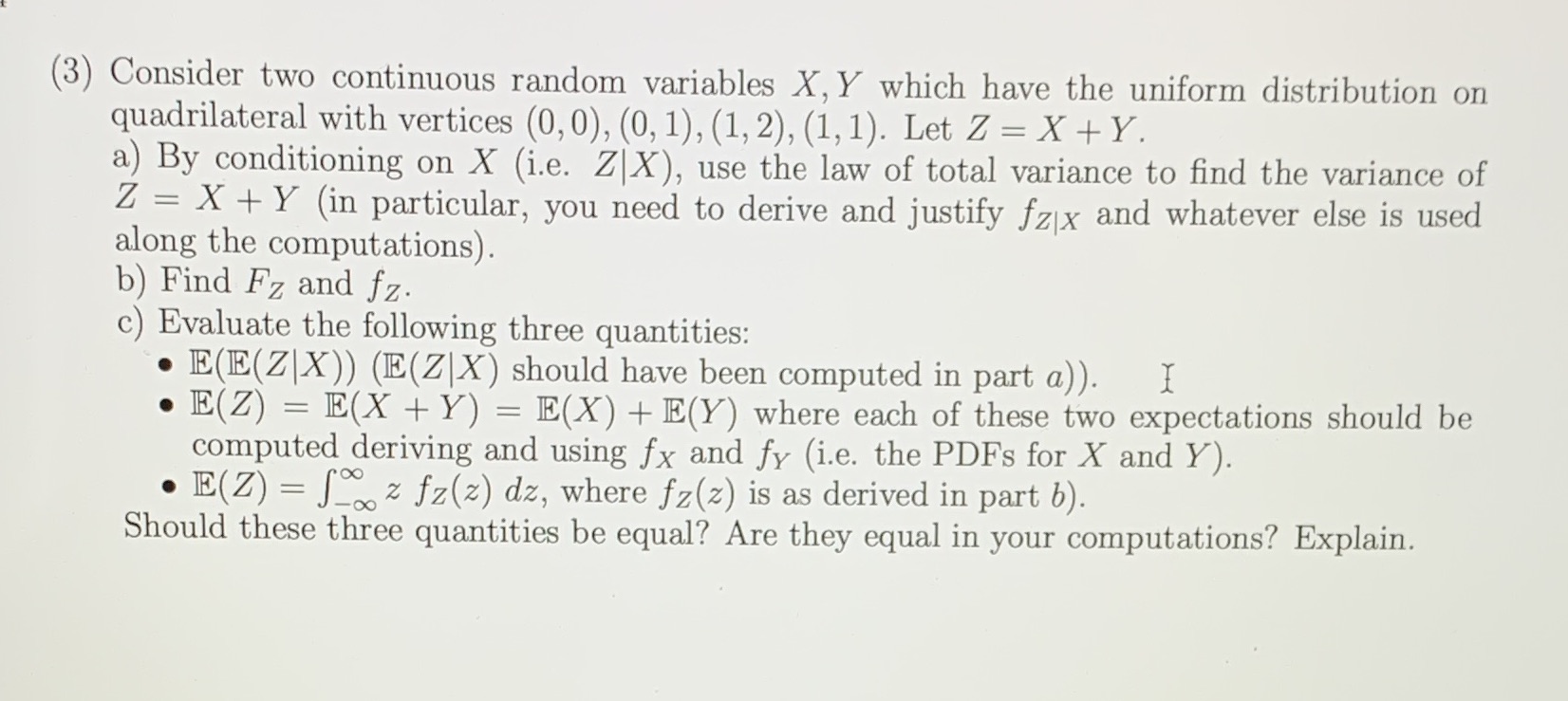
(3) Consider two continuous random variables X, Y which have the uniform distribution on quadrilateral with vertices (0, 0), (0, 1), (1, 2), (1, 1). Let Z = X + Y. a) By conditioning on X (i.e. Z X), use the law of total variance to find the variance of Z = X + Y (in particular, you need to derive and justify fz x and whatever else is used along the computations). b) Find Fz and fz. c) Evaluate the following three quantities: . E(E(Z X)) (E(Z X) should have been computed in part a)). I . E(Z) = E(X + Y) = E(X) + E(Y) where each of these two expectations should be computed deriving and using fx and fy (i.e. the PDFs for X and Y). . E(Z) = S z fz(z) dz, where fz(z) is as derived in part b). Should these three quantities be equal? Are they equal in your computations? Explain
Step by Step Solution
There are 3 Steps involved in it

Get step-by-step solutions from verified subject matter experts
 Study Help